Some sources say that the main reason was that there were some 2,000,000 rounds left over at the end of World War I from the earlier fabric-belt-fed 2-pdr QF Mk II. At the rate the octuple mounts used up ammunition I don’t think this is valid.
Let’s look at a bit of the history.
In 1930, the multiple pom-pom, officially the 2-pdr QF MkVIII, was an advanced close-range anti-aircraft weapon – certainly with more hitting power than the 0.5”MG MK III, both out-ranging it and with a heavier projectile.
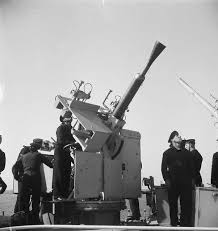
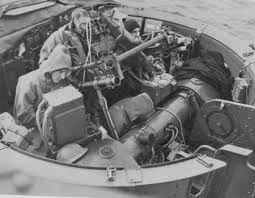
Typical single 2-pounder mount, the Mk VIII
Rapid development in aircraft performance saw the pom-pom obsolescent by 1939 yet it continued to be manufactured [over 7,000] and installed until the end of WW2. Like so many weapons and weapon systems, the hype exceeded the efficacy. Low muzzle velocity, [LV 1,920 fps, 585 mps] the lack of tracer ammunition and a satisfactory explosive shell were disguised by the sheer volume of fire – around a theoretical 100 rounds per minute per barrel – for an eight-barrelled mounting although the barrels fired in pairs for the quad mount the guns fired in pairs and in quads in the octuple mounts.
Surely no aircraft could survive that?
Wrong!
Why?
Well, let’s look at range which was as follows:
LV Max. Range 3,800 yds [3,475 m] Effective Range 1,200 yds [1,100 m]
HV Max. Range 5,000 yds [4,572 m] Effective Range 1,700 yds [1,550 m]
AA Ceiling 13,000 ft [3,960 m]
However, at 1,920 fps [640 yds ps] it would take 20 seconds to reach that height. At, say 300 mph, an aircraft could travel 1.67 miles. So, the aim-off, for an aircraft flying straight, level and at right angles to the gun was considerable.
The high velocity projectile was introduced [HV 2,400 fps, 732mps] but the ammunition was not interchangeable between LV and HV guns. HE tracer was introduced in 1941. Tracer was a double-edged sword. It told the gunners where they were firing but also told aircraft where the danger lay. All ammunition eventually came in 14-round clips [about 42 lbs] which could be joined together in a continuous feed. Since fire rate was some 100 rounds per minute [rpm], that meant that 7+ clips had to be fed continuously from feed boxes fitted to the mounts [112 rounds for quads, 140 rounds for octuples] then topped up as these were being emptied. A Herculean task even for a well-trained crew. I believe that the guns could not be loaded while firing. Had they done so, the loaders [one for each feed box] would have had to follow the gun as it trained and elevated all the while trying to connect new belts to the last one in the box. In practical terms, the gun mounting would simply have to stop moving and the barrels go into a horizontal mode for the boxes to be loaded. So, an apparent blistering fire from 4 or 8 barrels stops for reloading….just at the very moment it is needed!
The practical rate of fire was in the vicinity of 50-75 rpm.
The 40mm Bofors – basically the Army’s Mark III LS [Land Service] hand-operated single mounts – that first found its way in Royal Navy use [some 500 of them eventually] were ones rescued from the Army during the evacuation from Norway in 1940. The first official installations – as distinct from simply being placed on their land-based mounting wherever there was room and a good firing arc offered – were aboard battleships Nelson, Prince of Wales, cruiser Manchester and monitor Erebus. The water-cooled twin versions [Marks IV and IV/I] were first fitted in November 1942 to the sloop Wimbrell.
The Bofors, even in single form, quickly showed its superiority to the pom-pom and was considered twice as effective against low-flying torpedo bombers but not significantly better against dive bombers. Nevertheless, it became common practice, as production allowed, to replace quad pom-poms with twin Bofors. The Bofors mounts weighed:
Mk III 1,120 to 1,163 lbs. [508 to 528 kg]
Mk IV 9,800 to 13,000 lbs [4,445 to 5,897 kg]
Whereas, the quad pom-pom mount weighed 35,840 lbs [16 tons or 15 metric tons]
So, any replacement of quad pom-pom with twin 40mm Bofors, or, to be most accurate the Ordnance, Quick Firing 40mm [OQF 40mm] saved considerable weight, always of great consideration as added topweight adversely affected stability.
The Bofors had a muzzle velocity of 2,800 fps or 853 mps [as compared with 1,920 fps of the pom-pom] and at an elevation of 45 degrees had a range of 10,750 yds [9,830 m] as compared with less than half that of the pom-pom. Similarly, its AA Ceiling was 23,500 feet – some 3,500 feet better than the pom-pom. Rate of fire, per barrel, was 120 rpm but the more practical rate was 80-90 rpm. Ammunition was Tracer, High Explosive, Semi Armour Piercing and Armour Piercing. The AA rounds normally self-destructed at between 3,000 to 3,500 yds. While each projectile weighed just under 2 lbs, the bursting charge was 0.150 lbs [2.4 oz].
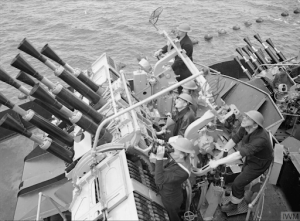
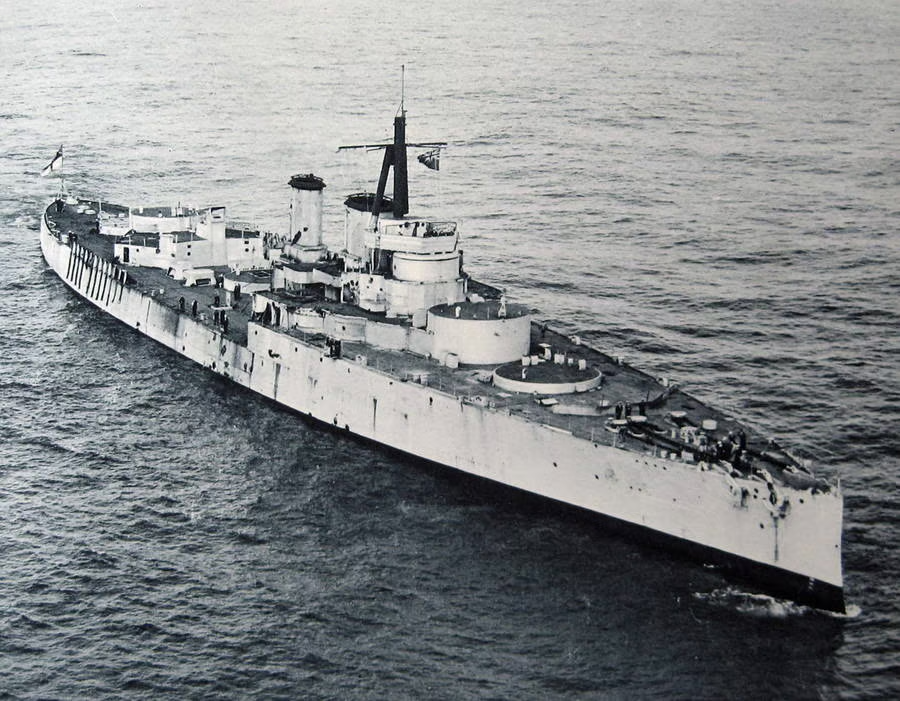
Typical 8-barrelled “pom-pom” mountings.