The main problem with axial-deck aircraft carriers– that is, ones using conventional arrested landings where aircraft having landed are parked well forward – was that there is no second chance to attempt another landing in the event of failing to catch an arrester wire. Crashing into a cross-deck flexible barrier was one alternative. Jumping that barrier and crashing into parked aircraft is another.
When the British discovered the concept of an angled flight deck in 1951 it provided aircraft carriers with not only the opportunity to recover and launch aircraft simultaneously it provided a “go around again” in the event of a botched landing.
In a sense, there already had existed very early in the development of carrier-borne aviation the concept of a separate landing deck and a separate taking-off deck. This was on the second conversion of the battle-cruiser HMS Furious when the earlier-fitted 160-foot long taking-off deck with hangar below was supplemented by a 300-foot-long landing-on deck aft. The two decks were connected with narrow decks either side of the superstructure which remained intact. Aircraft were man-handled along this deck past the superstructure. The arrangement, novel at the time (March, 1918), proved impractical. Landings were adversely affected by turbulence from the funnel and superstructure. Turbulence and very light aircraft do not mix well. The next step in the development of Furious and mimicking what had already been achieved in the earlier-developed Argus, the superstructure was removed and a near full-length flight deck was built between 1921 and 1925.
So, what has this got to do with the angled deck?
Since it had been possible, if somewhat precarious, to land aircraft directly into a cul-de-sac on the 300-foot-long landing-on deck of Furious, why didn’t someone consider angling that short landing deck either to port or starboard to avoid the “dead end” presented by the superstructure? Admittedly, Furious and her two sister-ships, Courageous and Glorious, were light battle cruisers designed specifically for the shallow water of the Baltic and, as such, may have lacked the stability necessary but the angled deck could have been duplicated on a light structure to balance the overhanging weight. Aircraft that botched their landing could have flown on to make another attempt. Instead of aircraft, having landed successfully (to port or starboard of the superstructure as wind direction dictated) then being manhandled along a skinny deck to the taking-off deck, they would have taxied to the forward deck where they could be parked and/or struck down below in a hangar. Alternatively, aircraft could land one side then taxi around the superstructure on to the unused flight deck and park there well out of the way for re-arming, refuelling etc.
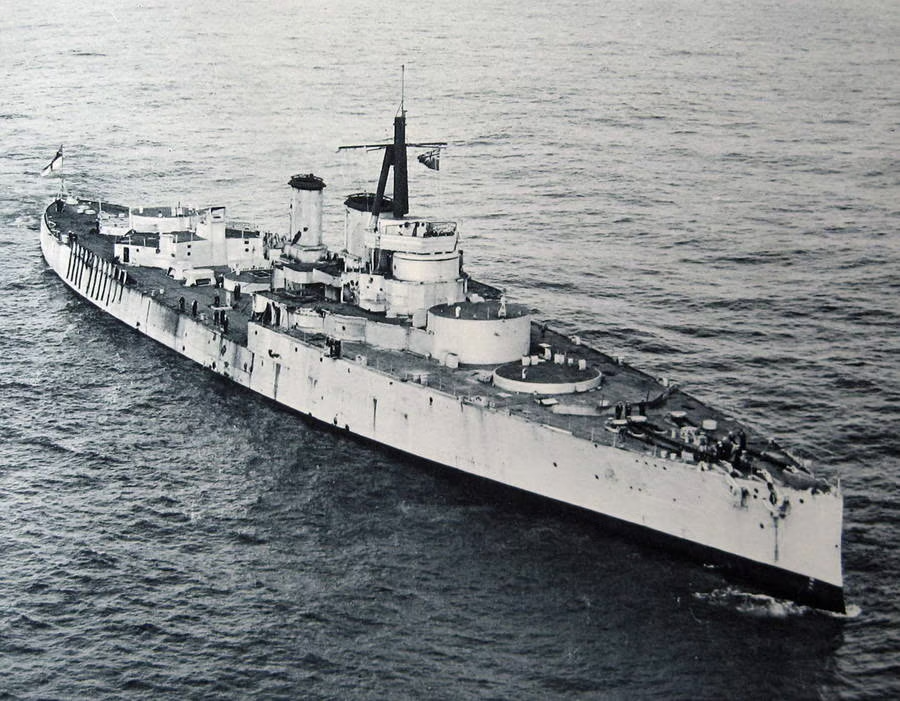
My drawing shows how the obsolete King George VI battleship, Centurion, which had been converted to a target ship, might have been the subject of a proof-of-concept conversion. The relatively low beam-to-length ratio and inherent stability of the battleship hull-form would have well suited this conversion. The basic principle of the minimalist conversion was to erect a light flight deck and retain the existing superstructure below, and above, the flight deck complete with arrester wires and basic netting around the perimeter. No hangar space would have been provided and no armament would have been fitted. I suspect that the funnels, cut down in height earlier in her conversion, would need to have been extended to avoid the turbulence problems experienced with Furious although some of that was from the superstructure which was in the direct line of landing. The aircraft shown are typical of the time: Hawker Nimrod fighters, Hawker Osprey reconnaissance/bombers and Blackburn Baffin torpedo bombers.
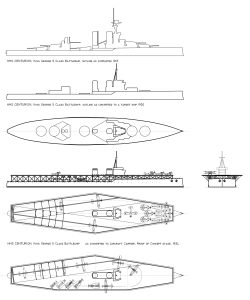
Had this concept proved successful, the next most logical step would have been to convert some later-built battleships, like the obsolescent R-Class, to full carriers with centre-line islands and hangars fore and aft, perhaps connected either side of the exhaust trunking. The lack of speed of the R-Class would not have been a disadvantage if they had been used to escort convoys for ASW patrols and, in the Mediterranean and the Arctic, for CAPs and for air cover had there been a necessity for mounting torpedo strikes.