Many historians look at photographs and immediately identify the masthead antenna on Australian River Class frigates (and their Bathurst Class corvette contemporaries) as an American SC air-search. Indeed, the Australian War Memorial and the Royal Australian Navy’s website’s photographic records’ captions tend to bear this out. In my opinion they are most probably wrong – at least insofar as those photographs that pertain to the early photographs of the Australian River Class frigates.
Australia – like Canada – developed its own radar systems, out of necessity not curiosity. The Council for Scientific and Industrial Research (CSIR) established a Radiophysics Division at the University of Sydney in 1940. The basic technology of using radio waves to detect aircraft was bought to Australia in 1939 and the equipment formed the basis for building systems for Australia’s armed forces. Significant redesigns took place to suit Australian conditions. A Shore Defence (ShD) radar was built and tested at Dover Heights (near Bondi, Sydney) in 1940 to detect shipping. It was innovative in that it used only one antenna on a tower, rapidly switching between transmitting and receiving radio pulses. It picked up a ship at Port Stephens, 90 miles away. A radically modified version was used as the basis of an air-warning (AW) radar, operating on a 1.50 metre wavelength also at Dover heights that detected an aircraft at 65 miles distance. A truly innovative advancement of this was the LW/AW (Light Weight/Air Warning) radar designed in September 1942. This was an air-transportable system of 2-3 tons that could be re-assembled in four hours. The equivalent American system weighed up to 40 tons. The antenna for the LW/AW and its supporting structure was designed by the chief electrical engineer of the New South Wales Government Railways (NSWGR), J.G.Q. Worledge, and produced in less than a month. This became known as the Worledge Array/Aerial/Antenna. The installation at Dover Heights detected aircraft at 5,000 feet altitude at 88 miles and at 25,000 feet altitude at 65 miles. Aircraft flying at 500 feet were detected at 10 miles. Fifty-six units were used by the Australian forces, 60 by the US Army in the Pacific and a further 12 in Burma by the British.
Not surprisingly, the RAN wanted a seaborne version of the LW/AW radar. Being sensitive to increasing top-weight high on the top of a ship’s mast, the antenna had to be lighter and smaller. This deficiency was made up by increasing power to 160 Kilowatts and this achieved a range of 60 miles. It was first installed and tested at sea in HMAS Kybra early in 1943. It was called the A286Q. The first locally-built River Class to commission was HMAS Gascoyne in November 1943. The A286 as it became known was in full production by then.
I think it fair to say, therefore, that the A286 was an almost totally Australian-derived air-warning radar. It may have shared some commonality with the British Type 286 insofar as the basic electrical componentry/circuitry was concerned but was made unique by the adaptation of the NSWGR-derived Worledge Antenna and the resultant improved performance.
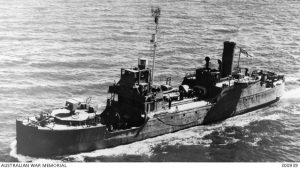
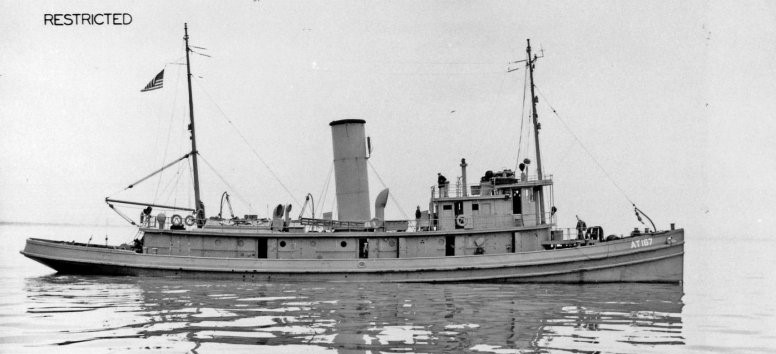
HMAS Kybra used as a trial ship for A286Q radar with Worledge Antenna.
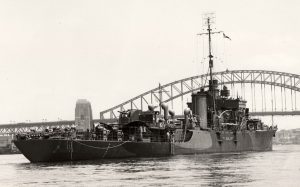
The River Class frigate HMAS Gascoyne in 1943 with A286 radar and Worledge Antenna.