

Reviews
AUSTRALIAN NAVAL INSTITUTE
November 11, 2025
Reviewed by Tim Coyle
In Two Many Ships Too Late the Australian author John Henshaw forensically analyses the World War One United States emergency ship construction program under the United States Shipping Board (USSB) through its Emergency Fleet Corporation (EFC), and the British Emergency Ships program.
Drawing on specialised published works, official sources and prior data collections, Henshaw posits that the EFC’s emergency program produced too many ships which led to mass redundancies following the November 1918 Armistice. Shipbuilding continued into the 1920s to meet contracts which could not be cancelled. The story Henshaw tells in this book is a fascinating study in industrial mobilisation, the lessons of which can be transposed to today.
When the US entered World War One in April 1917 it faced a major shipping quandary. Despite the exponential industrial development in the latter half of the 19th and early 20th centuries, merchant shipping capacity was lacking; less than five percent of world shipping flew the US flag. US military planners assessed the war could last until August 1919, requiring the transporting of the American Expeditionary Force (60, 80 or 100 divisions comprising 2.5, 3.35 or 4.26 million troops respectively) to the European battlefields, logistically supporting them and returning them after hostilities.
Authorities had foreseen such a continency and established the USSB on 19 September 1916: ‘for the purpose of encouraging, developing, and creating a naval auxiliary and naval reserve and a Merchant Marine to meet the requirements of the commerce of the United States with its territories and possessions and with foreign countries; to regulate carriers by water engaged in the foreign and interstate commerce of the United States for other purposes’.
Ten days after the US entry into the war, the USSB founded EFC ‘to acquire, maintain and operate merchant ships to meet national defense and foreign and domestic commerce’. The USSB’s ‘mission statement’ was couched in bureaucratic policy language; however, the EFC was stridently focussed on providing merchant ships for the wartime emergencies.
After introducing the state of US shipping pre-war, and outlining the USSB and EFC establishment and guidelines, Henshaw dives into the various emergency measures to acquire ships. The first, and ostensibly the most direct, was seizing interned German ships. Ninety-five German ships were interned in US ports: the largest being the liner SS Vaterland. However, the interned German crews – idle since 1914 – went to work with relish to destroy ships systems at a cost of 11 million dollars. The next mode of emergency acquisition was requisitioning, which incurred the ire of foreign shipowners
Then came the new shipyards. Here Henshaw describes the vast capability of US industry to produce enormous materiel output from a virtual standing start. There were 37 shipyards with 234 slipways in April 1917; by March 1919 there were 181 shipyards with 891 slipways. The largest was the built-for-purpose Hog Island yard on the Delaware River in Pennsylvania. Built on swampland it had 50 slipways, seven wet docks, a detention basin and 28 outfitting docks. To feed the shipbuilding materiel requirements; prefabricated components were manufactured by a network of providers across multiple states. Henshaw provides details of Hog Island and several of the more prominent yards.
Of note is the preponderance of wooden ships built under the emergency program. Four hundred and thirty wooden ships (up to 4000 deadweight tons), tugs and barges of 16 EFC designs were built in 104 yards. Henshaw explains the technology advances which gave rise to steel ships over the latter half of the 19th century. This demand for steel outpaced the demand, hence the recourse to wooden construction. He gives comparative details of the steel versus wooden ships and clearly delineates the shortfalls of wooden construction. Nevertheless, while steel construction was superior, the EFC pushed for wood to close the shipping gap.
Few wooden ships survived beyond a few years of service – if that. Their inherent deficiencies saw many scrapped after the war. However, not to be outdone, the EFC contracted for 22 ships of ferro-concrete construction from seven yards; only 12 were completed.
The bulk of the book – Chapter 12: ‘The EFC Designs’ – describe in fine details, accompanied by the author’s drawings, the 135 EFC steel, wooden and concrete ship designs. Although caveated as to some of the numbers’ accuracy, Henshaw does an impressive job in documented these designs – using available records and the work of previous analysts. In addition to Henshaw’s drawings, archive photographs accompany the descriptions.
Henshaw then turns to the British Emergency Ships in Chapter 13. There the British faced similar problems but provided different solutions. There were nine British Ship Types designs, all of which are described in detail.
Henshaw concludes his study with descriptions of the US Cruiser and Transport Force and the Naval Overseas Transportation Service, thereby closing a most exhaustive and informative analysis of US and British war emergency shipping. Appendix A lists the EFC Ship Types, Appendix B, the EFC Ships by Design and Builders and Appendix C, Requisitioned Ships by Builder. Henshaw’s relaxed and personable writing style (’correcting’ a couple of American terminologies) facilitates absorption of the highly detailed content. One thousand nine hundred and twenty ships were built to EFC designs. Four hundred and twenty-one ships were requisitioned from US owners, and the British Shipping Controller requisitioned 52 ships.
The book’s title, Too Many Ships Too Late, reflects the historic fact that there were too many ships built. However, this was predicated on America’s ‘late’ entry into the war which, US authorities assessed, would continue into 1919. In the event they ‘over-catered’ but they should not be criticised for that. Henshaw’s final point is that the World War One emergency shipbuilding program proved to be a precursor to the several orders of shipbuilding magnitude demonstrated in World War Two.
To my mind how logistics contributed to the major wars of the last century is at least as interesting as the campaigns themselves. ‘Amateurs study tactics but professionals study logistics’, Is a much-bandied truism as relevant today as at any time in history.
There is much to learn from John Henshaw’s ‘Too Many Ships Too Late’ and its lessons of history extend to how a contemporary emergency might be managed.
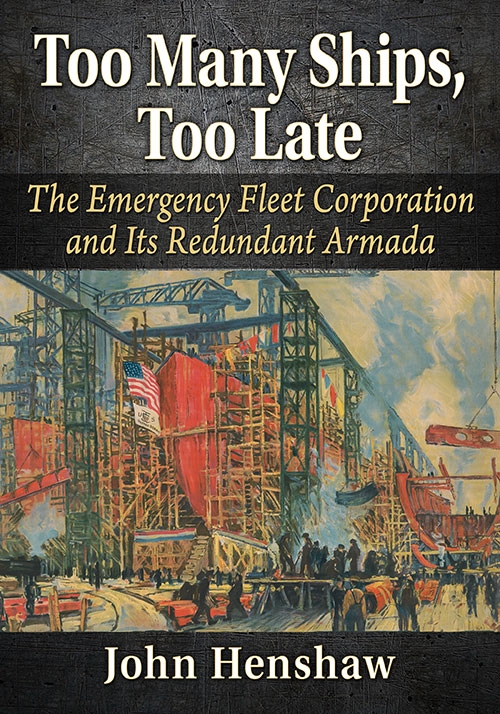
Too Many Ships, Too Late: The Emergency Fleet Corporation and Its Redundant Armada by John Henshaw
Review
Professor J. Schultz
John Henshaw’s Too Many Ships, Too Late: The Emergency Fleet Corporation and Its Redundant Armada tells the forgotten story of the World War One merchant shipbuilding effort and the consequences of brief American involvement in a war that foresaw far more ships than needed.
John Henshaw is the author of multiple books including A Bloody Business: Convoy PQ-17 (2025), Malta’s Savior: Operation Pedestal, 1942 (2024), V & W Destroyers: A Developmental History (2021), Liberty’s Provenance: The Evolution of the Liberty Ship from its Sunderland Origins (2020) and Town Class Destroyers: A Critical Assessment (2018). His well-researched books typically concern naval topics and provide excellent details which provide the reader with information that is often lacking in similar works.
Henshaw set out to tell the little-known story of the Emergency Fleet Corporation (EFC), a U.S. government owned company created by the United States Shipping Board (USSB) in 1917 shortly after President Woodrow Wilson entered the war. The USSB’s mission was “to promote, expand and regulate American commercial shipping.” [p. 20] It sought to provide merchant shipping for the United States as it entered World War One with a need to transport a large ground force to France at time of little sealift ability. The expected American Expeditionary Force (AEF) was originally estimated at least 60 divisions, which far outstripped the available merchant shipping then on hand. [p. 2] Therefore the EFC sought “to build merchant ships, quickly” which sounded great on paper but proved more complicated to implement. [p. 22]
The book is broken into sixteen brief chapters, an index, glossary, appendices, chapter notes, and bibliography. The inclusion of helpful photographs and especially line drawings of many different ship designs set the book apart from other such monographs that lack them. While this book focuses on merchant shipping, the rich range of vessels, appearances and other details make for a fascinating look at an era that escapes attention and is an excellent source for the ship modeler and historian alike.
One of the main challenges facing the Emergency Fleet Corporation (EFC) was whether to construct ships from steel or other materials. This dilemma arose from wartime shortages and other industries with priority for available steel. Henshaw devotes a chapter each to the wooden and concrete ships which are used by the EFC to meet their shipping goals, once it was clear that steel was in limited supply. The Pacific Northwest had a wooden ship-building ability, which the EFC learned about but while this was possible it did not match the intended timeline, which meant it was less than desirable. After all, the AEF needed to be transported in presumably short order and ships that took a long time to build were inherently insufficient for the needs. Eventually, many of the suddenly surplus wooden merchant ships ended up as the “Ghost Fleet,” an enduring eyesore in Mallows Bay, Maryland. [p. 59]
Outside of wooden ships, the EFC also considered concrete (actually “ferro-concrete”) ships, itself a fascinating and counterintuitive sounding decision. [p. 72] That concrete could be employed in shipbuilding on any scale sounds like a stopgap measure, Henshaw pointed out they “were a shipbuilding dead end,” suitable for only narrow applications. [p. 75]
The next five chapters detail where the EFC got or at least tried to get merchant shipping elicit discussion. As they stood at the edge of war in 1917, the United States was a neutral power, therefore a number of foreign ships might be in American harbors scattered around the country. In particular, the EFC looked to available German and Dutch ships in addition to those that could be requisitioned or conscripted among the limited merchant shipping sources. Other than those two potential sources, the United States looked internally to requisition and conscript ships intended for foreign countries and otherwise under construction or extant, which brought a number of challenges and controversies as well. [pp. 36-42]
As for German vessels, a large number were interred by the authorities or otherwise collected once the war officially began. That said, the amount of shipping gained did not amount to much when the transportation goals were considered and while these ships were certainly helpful, they could not handle the task and forced the authorities to consider other sources along with making considerable repairs. Accordingly, some German vessels, gained new names like the large liner SS Vaterland which transformed into SS Leviathan and served their new masters by ferrying troops and cargo. [pp. 28-31]
As for the Dutch vessels, their neutrality meant that America could in theory argue a belligerent’s international law right of angary (jus angariae) as the basis for their seizures, yet the Dutch did not agree with legality of the claim, nor were the ships taken from the Dutch going to meet the demand. It was always a means to an end, leaving the EFC planners forced to look elsewhere to meet their numbers and just cost more money along the way. [pp. 43-45]
The EFC assembled, built and otherwise amassed as many ships as possible given their steep expectations. When the war suddenly ended in November 1918, their efforts could not be fully appreciated due to ships under construction. However, in the light of time, the EFC managed to add a large number of vessels to the American registry but as Henshaw points out, it was never the amount they thought would be needed. [p. 186] All of this amassing also had consequences for the postwar period in that a glut of ships now existed and in many cases were not needed and/or little use could be found for them. This surplus of merchant shipping required reduction, which took some time to complete. The cost of all of this was staggering but of course war’s end should have been a blessing yet for the shipping it was just a further knock on the EFC’s record. What was never an easy task became compounded with the passage of time and swift end to the conflict, which the prewar planners could never have anticipated. The EFC did all it could to meet their assigned missions and perhaps too well, then their success brought new headaches, a thankless situation given all the effort already expended. For all its faults, the USSB / EFC did several important things: “revitalized American merchant shipping,” shipped untold cargo and the AEF across the Atlantic, employed thousands of shipyard workers and laid the groundwork for the next war’s industrial successes as part of the Arsenal of Democracy. [pp. 200-201]
John Henshaw’s Too Many Ships, Too Late: The Emergency Fleet Corporation and Its Redundant Armada fills an important gap in the scholarship regarding World War One shipbuilding; offering important lessons for future situations of such exigency which may well arise. The drawings of ships and black and white photographs provide welcome visuals chronicling the many different ships that were produced to fill the imagined need. Ship enthusiasts, logisticians and historians alike would all benefit from the book much as modern day decisionmakers.


Reviews
There are no reviews yet.