

Reviews
Reviewed by: Professor J. Schultz (Luzerne CC) has taught history and political science to community college undergraduates for over 20 years, specializing in military history, particularly World War II and the Cold War-era.
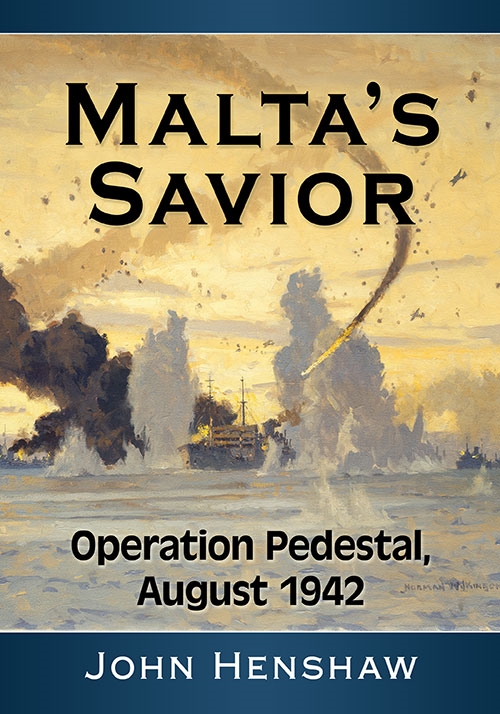
John Henshaw’s Malta’s Savior: Operation Pedestal, 1942 focuses on the effort to save Malta in early August of that year, within the framework of the overall British effort to preserve Malta as the key to control of the Mediterranean throughout the war.
Henshaw is an accomplished author, with a focus on naval history. His recent books include Too Many Ships, Too Late: A History of the Emergency Fleet Corporation in World War I (2024), V & W Destroyers: A Developmental History (2021), Liberty’s Provenance: The Evolution of the Liberty Ship from Its Sunderland Origins (2020), and Town Class Destroyers: A Critical Assessment (2018).
The seventeen chapters are grouped into two parts. Part I covers events from 11 June 1941 to 12 July 1942, and Part II deals with the day-to-day events of the Pedestal Convoy in July and August of 1942. In addition, there are eleven appendices, a glossary, bibliography, chapter notes and an index. There are also many black and white images, maps and line drawings which enrich the text and provide the reader with views of some ships which are typically overlooked in treatments of the topic. Each of the chapters has a series of subsections, like vignettes, that provide interesting, well-researched information which draws from several sources, critically giving a contrasting sense of what other authors previously said and how Henshaw feels about their findings, etc.
Henshaw proceeds with the central thesis that Malta was the keystone to Allied control of the Mediterranean. If it were lost, the successes that followed at El Alamein and elsewhere would have been in doubt (p. 1). Therefore, holding this isolated British outpost meant life or death writ large, and any attempts to reinforce it were worthwhile, regardless of the cost, given that Malta’s loss represented eventual defeat.
Part I (Chapters 1-5) provides the required background to understand the focus of the book, Operation Pedestal. Chapter 1 deals with the deeper background relevant to Malta, while Chapter 2 explores the Axis plans for an invasion of Malta, which the Germans called Unternehmen Herkules (Operation Hercules), and the Italians termed Operazione C.3. While this hypothetical invasion never happened, it remains one of the great ‘what ifs’ and should be discussed in a Malta-centric work. Chapter 3 looks at the early siege of the island in 1940, when few resources were available to defend it. Chapter 4 describes efforts to keep Malta supplied in 1941 and Chapter 5 covers 1942 relief efforts prior to Operation Pedestal.
Part II (Chapters 6-17) covers Operation Pedestal in great detail. Eight chapters describe the convoy’s hard fought, day-to-day experiences, with the remaining ones discussing the preparation, buildup, aftermath, and conclusion of the operation.
In August 1942, the Royal Navy assembled a singularly impressive naval force to resupply the critical island bastion, built around aircraft carriers, battleships, plus an array of cruisers and destroyers. These managed to deliver only a handful of the fourteen merchant ships, but those proved enough to keep Malta alive through the darkest time.
The vital Allied resupply convoy suffered attacks from air, surface, and submarine threats over multiple days which took a steady toll. Arguably, the greatest Axis threat to the convoy came from above, in the form of both German and Italian bombers, however, Italian and German small surface craft (MAS and MS boats, S-39 class E-boats / Schnellboot), took their toll as well, striking at night with torpedoes at often close ranges. (pp. 178-179) Additionally, Axis submarines played a role, the German U-73 sinking the old aircraft carrier HMS Eagle and, with one four torpedo salvo, the Italian Axum accounting for the anti-aircraft cruiser Cairo and damaging the light cruiser and operation flagship Nigeria, and the “precious tanker Ohio.” (p. 121)
Only four of the merchant ships reached Malta, Melbourne Star, Port Chalmers, Rochester Castle, Brisbane Star, and the battered tanker Ohio, which arrived in particularly poor condition, settling to the bottom of the harbor soon thereafter. Brisbane Star, among all the other troubles, was boarded by Vichy French authorities near Sousse, Tunisia but managed to depart, or might never have reached Malta due to internment. (pp. 206-208)
If Operation Pedestal can be viewed as a success, it was certainly a costly one. The Royal Navy lost four warships: aircraft carrier Eagle, cruisers Manchester and Cairo, plus destroyer Foresight, with another five warships damaged, the carrier Indomitable, cruisers Nigeria and Kenya, and destroyers Wolverine and Ithuriel, along with nine merchant ships lost. (p. 235) As Henshaw concludes, “Pedestal really was Malta’s savior. If it had not succeeded at that point in time . . . . Malta might well have had to surrender. Allied control of the Mediterranean would have been lost and Alamein and so much that followed put in jeopardy.” (pp. 243-244) The failure to neutralize Malta doomed the Axis in North Africa, as post-Pedestal their supply convoys continued to suffer vengeful Allied attacks from the “unsinkable aircraft carrier.” (p. 21)
Finally, the appendices deserve mention, as rich additional sources of information which elevate the book above potential peers. Those seeking greater detail will find much to like, ranging from chronological supply notes to codenames, orders of battle and ship & aircraft data. There is even an appendix about Vichy France, which again reinforces the thoroughness of the work.
Henshaw’s Malta’s Savior offers a nuanced look at summer 1942’s Operation Pedestal and the larger efforts to save Malta from the threat of Axis domination. His text is readable, well-researched, and exhaustive, with an eye for detail. It is well-supported by ample images and lavish line drawings of many ships such that it should be in any library, especially those interested in the British Empire and the Mediterranean in World War II.
Professor J. Schultz (Luzerne CC) has taught history and political science to community college undergraduates for over 20 years, specializing in military history, particularly World War II and the Cold War-era.
Critical Reviews & Ratings
ARGunners Magazine: Describes it as “the most riveting, best-ever portrayal of ‘Operation Pedestal'” and gives it a “highly, highly recommended” rating.
Reader Consensus: Reviews on platforms like Amazon highlight the book’s thorough research and its effectiveness in detailing the “desperate race” to save the strategic island.
Author Expertise: Readers appreciate Henshaw’s background as a naval history enthusiast and illustrator, noting that the book includes extensive technical drawings of the ships involved, many of which have not been published previously.
Key Themes Praised in Reviews
Tactical Detail: The book is noted for its “day-by-day account” of the planning and execution of the convoy.
Focus on the SS Ohio: Reviews frequently mention the focus on the heroic struggle of the SS Ohio, the tanker whose arrival with aviation fuel was critical to Malta’s survival.
Perspective: While some readers note it is written primarily from a British perspective, it is lauded for successfully capturing the “violence and valor” of the week-long battle against German and Italian forces.
Comparison to Other Works
Reviews often compare Henshaw’s work to other definitive accounts of the operation, such as:
- Max Hastings’ Operation Pedestal: Praised for its “gripping prose” and “high-octane adventure”.
- Peter C. Smith’s Pedestal: A long-standing classic known for its specialized focus on the aviation and dive-bombing aspects of the sea battle.


Reviews
There are no reviews yet.