

Reviews
Reviewed by Tim Coyle, Australian Naval Institute
The Liberty ship, together with the C-47 aircraft and the Jeep are considered by some to have contributed to victory in World War 2. This is undoubtedly a subjective opinion; however, there is no doubt that these designs were innovative, flexible and suitable for mass production as only the United States’ prodigious production capability could accomplish between 1942 and 1945. Two thousand, seven hundred and ten Liberty ships were produced between April 1941 and 10 July 1944 when production was switched to an improved ‘Victory’ ship. Generally regarded as a triumph of American design and production this book sets out to set the record straight.
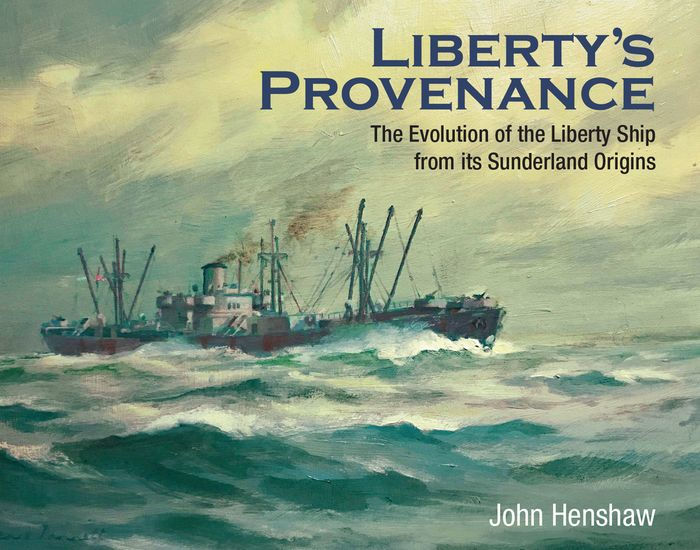
Liberty’s Provence author, John Henshaw, convincingly argues his case that the Liberty ship was far from being ‘all-American’ but was in fact a derivative of a British design conceived in the obscure North Sands, Sunderland shipyard of Joseph Thompson and Sons Limited. The surplus of World War One merchant ships – built in British and American yards to replace those lost by U-boat attack – caused a slump in post war construction which lasted well into the 1930s. The Thompson yard used the depressed market to develop a cheaper, better performing 10 000-ton cargo ship. Young Robert Cyril Thompson used National Physical Laboratory testing tanks to model varying hull forms. A hull featuring a fuller entry, a raked bow and finer lines leading to a stern post with a cruiser stern and semi-balanced rudder was matched with an improved vertical triple expansion engine. Although not new concepts, Thompson put these features together in the SS Embassade, launched in July 1935. Embassade proved successful in service and a slightly longer and wider SS Dorington Court was completed in May 1939.
In September 1940 Thompson, then 33 years old and highly regarded in the industry for his competence and, in the Admiralty’s opinion the best practical merchant ship design as demonstrated in Embassade and Dorington Court, was asked by the Controller of Merchant Shipbuilding and Repairs to lead a Merchant Shipbuilding Mission to the US, His task was ‘…to endeavour to obtain at the earliest possible moment the delivery of Merchant tonnage from USA shipyards at the rate per annum of about 60 vessels of the Tramp type each averaging about 10 000 tons deadweight and of 10.5 knots service speed, loaded, in fair weather and to make provision for the building of 30 such vessels’.
Twenty days after the Mission’s arrival in the US it met the formidable industrialist Henry J Kaiser. The British accepted that new yards would have to be established for their ships and Kaiser was best placed to oversee the project. The British had to accept that the cost of the shipyards would have to be amortised over the 60 ships. Admiral Emory S Land, head of the US Maritime Commission and focussed on US shipping requirements, saw value in getting the British to pay for the new yards which then would be turned over to US production. Contracts were signed on 01 December 1940 with Kaiser for two yards, one In Richmond, California, and the other in Portland, Maine. Thompson then left for Britain; enroute his ship was torpedoed off the Orkneys and he spent nine hours in freezing conditions in a lifeboat before rescue. He had the forethought to take his briefcase with him containing the contracts when he abandoned ship. On arrival back at the Admiralty the sodden contracts were retyped for the Chancellor of the Exchequer’s signature.
Henshaw’s argues the gestation of the Liberty ship was: Embassade and Dorington Court leading to derivatives built by Thompson’s: Empire Wind class (10 ships completed October 1940-October 1941) and Empire Liberty class (13 ships completed November 1941 to September 1944). According to Henshaw, Empire Liberty as the model for the Kaiser-built Ocean class (completed November 1941 to October 1944). Two further offshoots were the ‘Fort’, ‘Park’ and ‘Victory’ ships built in Canadian yards (January 1942 to March 1946) and finally the definitive ‘Liberty’ ship.
The book’s first seven chapters are cover the Battle of the Atlantic in World War One, British and US emergency ships designs, the US Shipping Board and Emergency Fleet Corporation, the shipping situation between the wars and the second Battle of the Atlantic of World War Two. As such this book provides an excellent overview of wartime emergency shipping which leads to the main topic of Thompson’s designs and the Liberty ship saga.
As with many historical records, revisionism and inaccuracies, intentional or not, come to be accepted as fact, particularly as time elapses. So it appears to be with the Liberty ship and Henshaw’s book is dedicated to ensuring that Thompson’s yard is credited for the genesis of Liberty, contrary to claims made by US interests. The book is meticulously researched with a many illustrations, not least of which are ship drawings largely executed by Henshaw himself.
The Liberty ship served for many years after the war until sold out of commercial service, but many remained in in the RN and the US services. The fine-lined, commodious hulls found uses in many converted guises.
The hero of the story is Robert Thompson. After accomplishing his mission to the US, and surviving a sinking, he sought to join the Royal Navy. However, the Admiralty decided his work was too important; he promptly joined the Royal Air Force as an aircraftsman second class and flew as a flight sergeant flight engineer in Liberator bombers. Awarded Commander of the British Empire in 1941 for his shipping work, the ribbon of the award on his RAF uniform must have raised some comment!
This is a book for ship enthusiasts and those who enjoy reading finely argued technicalities. While over 70 years have passed since these events the record of the Liberties has been definitively corrected. Liberty’s Provenance does this exceptionally well.
Editorial Reviews
Reviews
“This is without doubt a fascinating and beautifully presented account of the evolution of a particular maritime lineage, during a very generally exciting and interesting period of world history…. A fascinating book, well worth having and reading.” –A Question of Scale: A Wargaming Work in Progress
“This is a superb production replete with very clear line drawing by the author and a fine array of photographs that back up his very clear and lucid text. It needs to be on the shelf of anyone seriously interested in the naval and maritime history of World War II or the story of the development of merchant shipping in the twentieth century.” –Nautical Research Journal
“This is a book for ship enthusiasts and those who enjoy reading finely argued technicalities. While over 70 years have passed since these events the record of the Liberties has been definitively corrected. Liberty’s Provenance does this exceptionally well.” –The Australian Naval Institute
Buyer Reviews
David McIntyre
5.0 out of 5 stars
A fine study of Liberty ships and wartime standard ships.
A fine study of Liberty ships that also places them in the timeline of other wartime standard designs of all shipbuilding combatant nations of both world wars, fluid writing, good artwork and very interesting photographs, if you are interested in this subject this book is not one to miss.
Damien Burke
4.0 out of 5 stars
The Battle of the Atlantic’s unsung hero and its true origins
This is a really nicely presented book in an unusual landscape format dedicated to putting right the myth that the Liberty ships of WWII were an entirely American affair. In fact, as the book details, the design was a direct descendant of British ship designer Robert Cyril Thompson’s designs for a versatile, inexpensive and easy to construct cargo ship.
Unlike many factual volumes, this one documents the author’s own research process with his assumptions, guesses and solid reasoning all detailed to varying extents. This really is a refreshing way to present research – he compares existing sources with his own research, points out obvious inaccuracies in published material and backs up his own guesses where information is insufficient to make a definitive statement.
It’s not just a one trick pony, though – as well as documenting the origins of these ugly ducklings and unsung heroes of WWII, the author illustrates the many variants (including post-war conversions) in beautifully done line drawings which graphically demonstrate the lineage and underline the central purpose of the book. It really is incredible to think that a 1930s design of a cargo ship from a small Sunderland company not only helped win the Battle of the Atlantic but went on to form the basis of countless other ships including mini aircraft carriers and even – I believe – the first Royal Navy ship to launch a guided missile (HMS Girdle Ness as the Sea Slug trials ship).
Photographic coverage is entirely monochrome and occasionally a little bit weak, with many photos sourced from the internet and reproduced at insufficiently high resolution resulting in muddy and pixelated images on some pages. A deeper search of physical image archives would have been rewarding I feel – though given the niche nature of this volume, potentially cost-prohibitive.
Anyway, a fascinating volume on what proves to be an unexpectedly complex and interesting subject – recommended.
Sebastian Palmer
4.0 out of 5 stars
Fascinating and beautifully illustrated
A fascinating and very detailed account of the evolution and origins of the famous Liberty ships of WWII. Well illustrated with both photos and very nice line drawings, the latter by the author himself. Dedicated to Cyril Thompson, the ‘unsung hero’ of the Liberty ship story, of Sunderland shipbuilders Thompson’s, whose drawings and vessels were the antecedents to these famous vessels.
Bayard B.
5.0 out of 5 stars
Excellent book on the antecedents of the US “Liberty” WW II cargo ship
This is an excellent book on the antecedents of the US “Liberty” WW II cargo ship. It clearly describes the naval architectural history of the ships designed and constructed by Robert Cyril Thompson and his father’s shipyard Joseph L. Thompson & Sons, Ltd in North Sands, Sunderland, UK. The ship design and construction genealogy goes “Embassage” →”Dorington Court” → “Empire Wave” → “Empire Liberty” → “Ocean” → “Liberty.” The British “Ocean” was of riveted construction per standard British practice of the time. The American “Liberty” was based on the “Ocean” but was modified to be of welded construction to allow prefabrication and much faster overall construction time. Chapter 14 “The Essence of the Liberty Ship” describes the detailed design differences between the “Ocean” and the “Liberty.”
This speed of construction came at a price. A “Liberty” could be built in an average time of 50 days using unskilled labor or at least a work force that had almost no previous experience constructing ships. A US “Liberty” cost approximately $2 million and required a labor effort of 600,000 hours. A British “Ocean” required six months to construct, cost approximately £180,000 ($900,000), and required a labor effort of 350,000 hours.
The text is accompanied by period black and white photos and many excellent line drawings depicting decks and longitudinal section views (all CAD generated).


Reviews
There are no reviews yet.