In September 1941, two years after the commencement of World War II, Britain was beleaguered relying on trans-Atlantic convoys to keep it supplied with foodstuffs and the matériel to survive. There were two types of convoys that left from North American ports: the HX series which were, technically, fast convoys (if you can call 8+ knots fast) and SC series which were slow convoys – very slow convoys.
SC-42 – a convoy of 61 merchant ships – left from Sydney, Nova Scotia on 30 August 1941 and was joined by another five from nearby Wabana and four from Iceland. The convoy was bound for Liverpool, its route to take it in a wide northern arc close to the southern tip of Greenland before entering the narrow gap, a choke point, between Northern Ireland and Scotland and then into the Irish Sea.
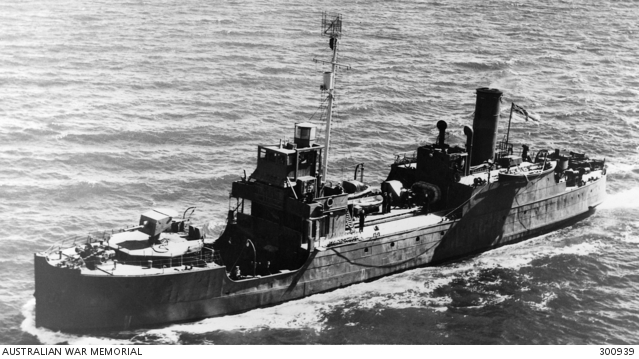
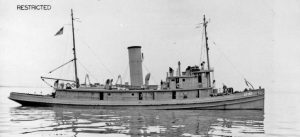
There were two vessels that were counted in SC-42’s composition that were of note and which typified Britain’s desperation at the time. In columns 8 and 12, and both in row 5, were two identical tugs – or tugboats if you are American, the boat aspect being applicable in both cases as they were only 150-feet long. Barwick was towing another tug, C. H. Spedden, and Bascobel was towing another tug, Socony 8. Neither of the towed vessels were included in the convoy’s composition.
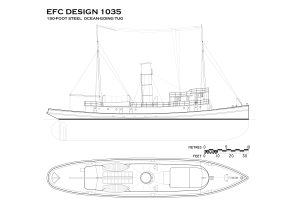
My research indicates that Barwick and Bascobel were built to the EFC’s Design 1035, officially described as a 150-foot steel ocean tug and had been transferred to British ownership together with C.H. Spedden and Socony 8. It is possible, indeed highly likely, that Spedden and Socony were also of the same type.
DESIGN 1035
Some sources credit the builders as Providence Engineering and not Bethlehem Shipbuilding Corporation at its Elizabethport, New Jersey shipyard. As such, they are frequently referred to as PROVIDENCE Type. On 5 December 1917, the Chief of the Navy Office pointed out to the USSB that the demand for tugs was greater than the contracted supply. The design was based on the W.B. Keene bult by the Staten Island Shipbuilding Company in 1913. Thirty tugs were ordered by the EFC but only twenty were built between February and November 1919. Eight were transferred to the USN and USCG but appear to have been decommissioned in or shortly after World War II. The last tug, W.B Storey (ex-Basford) in commercial use, was scrapped in 1968 but had probably been re-engined with a diesel. Several soldiered on until the early 1960’s.
Type: Steel Ocean Tug
Deadweight Tonnage: 526 light, 1,035 full load, GRT between 396 and 437.
Dimensions: 150’0” LOA (141’3” LBP) x 72’0” beam x 28’0” draft
Propulsion: 2 x boilers, coal-fired, VTE, 800 NHP, single shaft, 10 knots.[i]
Records vary as to what happened to Barwick and Bascobel. The common belief is that Bascobel turned back at some stage for reasons unknown. However, more research revealed that Bascobel had lost its tow in severe heavy weather on 3 September when approximately 300 miles north-east of Belle Isle. Despite searching, Socony 8 could not be found. However, on 7 September, the battered tug made it to St. John’s. Bascobel had, in the meantime, continued independently to Reykjavik, Iceland, arriving there on the 13 September. On 18 September the tug departed on an independent passage to the UK. There is some ambiguity as to when and where Bascobel arrived in the UK: Liverpool on 20 September, which seems unlikely given the distance to travel, or the Clyde on 25 September which seems much more likely.[ii]
Hague’s records show Barwick as having been part of SC-42 to Sydney only, arriving there on 9 September indicating that it was, indeed, Barwick and not Bascobel that turned back. It operated at Sydney as a tug until 12 October then made its way to Lagos by 27 October 1942 via four convoys that took it via Hampton Roads, Florida, Cuba and Freetown. These waters are muddied by the reference in Mitchell and Sawyer’s Empire Ships of World War II, as Bascobel being Empire Bascobel having been taken over by the MoWT then reverting to Bascobel in 1948 and scrapped in the USA in 1963. Lenton and Colledge in Warships of World War II list Barwick as being a rescue tug with the pendant number W.174 in 1942 then Behest in 1944, Sansone in 1947, Opus in 1953.[iii]
Whichever record is correct, these tugs made perilous crossings – perilous not just because of U-boats, for which they were a small target anyway, but because of their small size and limited bunkerage capacity. Barwick was abandoned in the Staten Island Boast Graveyard on the west shore of Staten Island, New York City in 1963.
I wondered why tugs – particularly old, coal-fired ones with very low freeboard – were so needed in Britain that they would be purchased in the USA and then have to face a dangerous journey. I had no answer to that other than, perhaps, simply attrition from the Nazis bombing harbours and the like. However, less than three years later there was a shortage of tugs for Operation Neptune, the amphibious landings in Normandy that commenced Operation Overlord. They were needed to tow the components of the artificial harbours, Mulberry A and B, from southern ports in Britain to northern France – the floating breakwaters, the concrete caissons, floating roadways and piers. Readers should look out for my upcoming book: Neptune’s Mulberries: Normandy’s Harbours, June 1944.
[i] John Henshaw, Too Many Ships, Too Late: The Emergency Fleet Corporation’s Redundant Armada, pp. 126
[ii] www.convoyweb.org.uk/ports/index.html?search.php~armain
[iii] H.T. Lenton & J.J. Colledge, Warships of World War II, p. 273