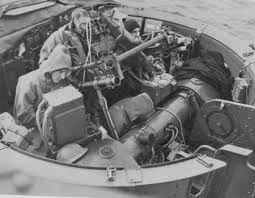
The five R Class – or Revenge Class – battleships came after the Queen Elizabeth Class and before the Nelson Class and were commissioned in 1916-1917: Revenge, Resolution, Royal Oak, Royal Sovereign and Ramillies. Royal Oak was a very early war loss – torpedoed in Scapa Flow in October 1939 – and the others were relegated to the Eastern Fleet early in 1942 as the 3rd Battle Squadron where they were a dubious asset because of their slow speed (21 knots at the very best) and poor range because of inadequate feedwater for their 18 boilers.
By late 1943, early 1944, they were, to all intents and purposes, laid up in Reserve. Revenge and Resolution had their 15-inch gun barrels removed, Ramillies saw some action for shore bombardment during the Normandy landings and Royal Sovereign was transferred to the USSR.
But, what if a better use had been made of these obsolete ships?
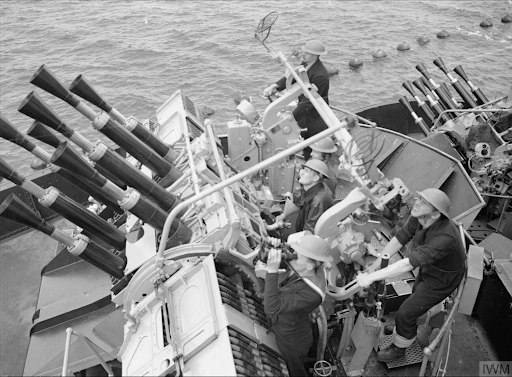
While a theoretical top speed of 21 knots was deemed inadequate for fleet actions, this would be no drawback if they were used as armoured convoy escorts on the Murmansk/Archangel run with an emphasis on providing stable anti-aircraft platforms. While speed was not an issue for a convoy making, say, 8-10 knots, the 21-knot – say 18-knots anyway – would allow them to manoeuvre and place themselves at the best advantage to provide controlled barrages equal to, if not better than, the converted C-Class cruisers.
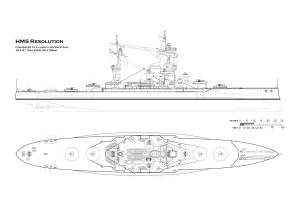
My first drawing is of Resolution and shows how she appeared in early 1942. The second drawing shows how she would have appeared if converted by simply replacing the main 14-inch armament with twin QF 4-inch XVI mounts in barbettes giving a total of 16. While 16 does not seem a huge improvement it is important to note that there is a separate HACS for each pair of mounts; one forward, one on each beam and one aft. There are two octuple pom-poms and two quads plus 20 x 20mm Oerlikons in single mounts. The 6-inch casemounts have been removed and plated over. Ballast would almost certainly have to be used to counter the loss of topweight although extra feedwater tanks would have overcome the inherent problem of the class.

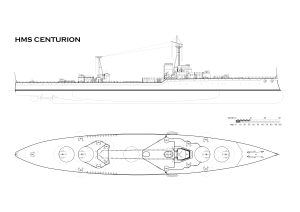
The earlier-built King George V Class Centurion could have been an easier candidate to test the concept. She was disarmed and used as a radio-controlled target ship in 1927, then decommissioned then considered as a conversion to an anti-aircraft ship for the ill-fated Norway campaign. This never eventuated but she was converted to vaguely resemble – at least from a distance – the King George VI Class battleship, Anson, with dummy guns, funnel, superstructure and minimal close-range weapons in 1942. Her ultimate fate was as part of a breakwater of blockships off Omaha Beach on 7 June 1944. Severe storms undermined the seabed and broke her back later in June.
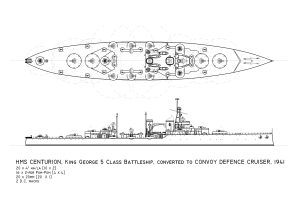
My first drawing of Centurion converted to what I have termed a Convoy Defence Cruiser illustrates how 9 twin QF 4-inch XVI mounts (2 forward, 2 aft, I midships, 2 on each beam) could have been installed using the 13.5-inch barbettes forward and aft. However, only two HACS directors would limit effective barrages. The 4-inch casemounts would have been redundant and been plated over. Close-range weaponry is 16 pom-poms (4 x 4) plus single 20mm Oerlikons wherever there was space for them.
The second drawing eliminates the midships mount for two additional beam mounts and replaces the obsolete pom-poms with twin 40mm Bofors and adds four single mounts. The big improvement is in the two additional HACS mountings midships (still not as good as the US tachymetric type).
The third drawing shows Centurion as she was when scuttled to form a breakwater off Omaha Beach on 7 June 1944. Precise details as to the close-range armament fitted are vague but some photos show what looks very like Rolls Royce 2-pounder Mk XVI mounts – an unusual choice given they were more suited to anti-surface use, as fitted to coastal forces.