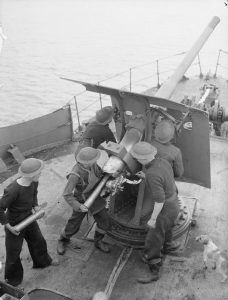
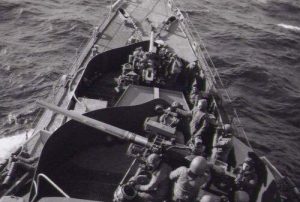
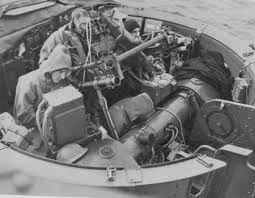
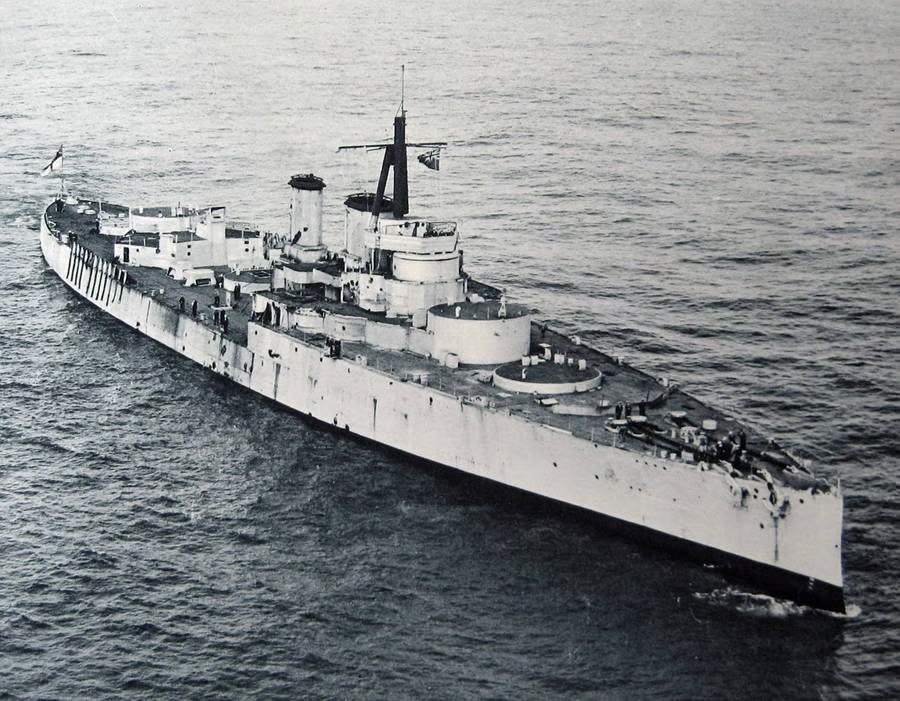
It is interesting to note the frequent disparaging comments about the American 3”/50 cal, presumably the Mk 20 or 22, the difference being only minor relating to the type of barrel and its construction. fitted as standard equipment on the Captain and Colony Class frigates.
There’s the “Everyone knows the 3-inch projectile will not put a dent in a pat of butter” quote from the Captain of HMS Duckworth.
Captain Donald Macintyre’s book, U-Boat Killer (page 139) contains these comments:
“The principal weakness of these ships [the Captain Class] was the main gun armament. I cannot imagine where the Americans found the short-barrelled 3-inch blunderbusses with which they were furnished – elephant guns, I remember, we nick-named them. They fired a minute shell of, I suspect, solid steel with no explosive charge for on the only occasion we fired them in anger they were seen to bounce off the target without exploding”.
Here’s another instance:
On 26 January 1945 four frigates, HM Ships Aylmer, Bentinck, Calder and Manners forced U-1051 to the surface with depth charges whereupon the submarine fired on the frigates. Lt. A.D.P. Campbell, RN of Aylmer, apparently being nearest, chose to successfully ram U-1051 and sink her on the common understanding that the 3”/50 cal guns had trouble penetrating the hull of a submarine and simply bounced off. Whether that was something experienced in that engagement or was simply regarded as common knowledge is not known.
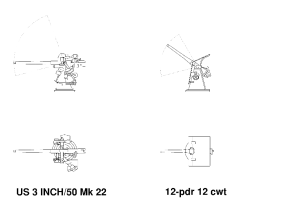
The problem seems to have been hitting power, not range. The nearest comparable gun in the RN’s armoury was the venerable QF 12-pounder 12 cwt (dating from 1894) which was used as the anti-aircraft weapon of choice, for instance, in the RCN’s early River Class frigates, was fitted to many of the early Australian Bathurst Class corvettes for the RAN and all of the Bathurst Class corvettes for the Royal Indian Navy as their main weapon. It was the weapon that replaced the aft 4-inch/50 cal – a low-angle gun – on the Town Class destroyers in the Stage 1 Modifications, it was used to replace the aft bank of torpedoes in many of the pre-war RN destroyer classes – again as an anti-aircraft weapon but with use as an anti-submarine weapon too. The 12-pounder had a three-inch bore also and both guns had reasonable muzzle velocity: the 12-pounder 2,264 feet per second and the 3”/50 cal 2,700 feet per second. While the 12-pounder’s ceiling at maximum elevation was only 19,000 feet the 3”/50 cal was 74% better at 33,000 feet. Similarly, the 12-pounder was down in range: at 40 degrees elevation only 11,750 yards as compared with 14,600 yards at 43 degrees elevation – 24.25% better. However, the big difference in favour of the 12-pounder appears to have been the bursting charge that could be delivered to the target even if it wasn’t at as great a range. The British gun had 1 lb 3 oz (19-ozs) whereas the American gun only .74 lbs (11.84-ozs) – that’s 60.47% more hitting power in the British gun.