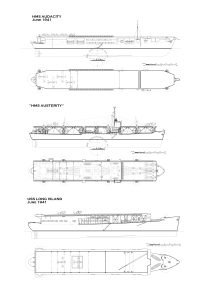
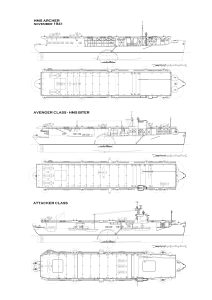
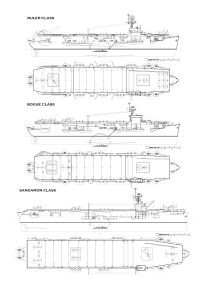
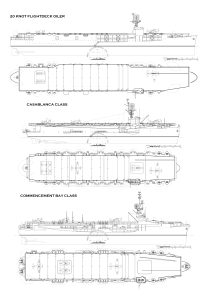
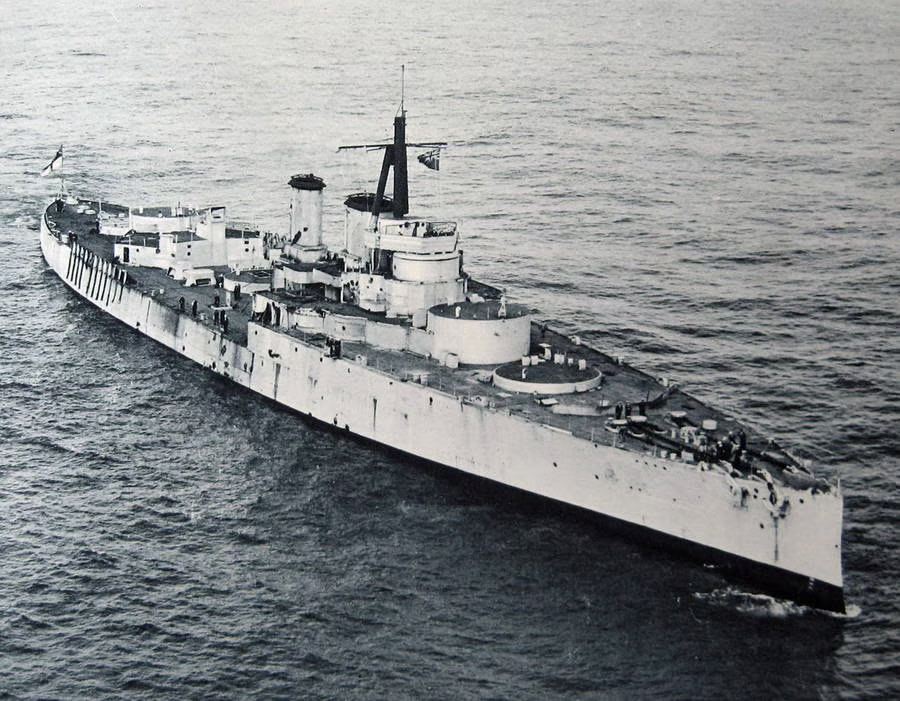
Predictably, when World War II commenced, Britain was caught out, desperately short of ocean-going convoy escorts such was the inattention paid to this form of warfare and aviation at sea by way of Escort Carriers was just one aspect. In desperation, HMS Courageous, a fleet carrier was used in a “hunter-killer” ASW patrol off the coast of Ireland and torpedoed by U-29 on 17 September 1939 (two weeks after war was declared). Courageous, like its near sister-ships Furious and Glorious, had been retained past their used-by date because of procrastination with proceeding with replacements. She was, nevertheless, a big loss and should never have been put to this use. Land-based maritime patrol aircraft could have done that job – had they been available. But that is yet another story of lack of foresight.
Having decided, belatedly, in 1941 – almost two years into the war – that Escort Carriers were a good idea, and then placing orders with America via Lend Lease, why did Britain feel it was necessary to do its own thing and convert five quite valuable merchant ships hulls when it was already committed to nineteen quite adequate Merchant Aircraft Carrier conversions? Wasn’t this a bit like re-inventing the wheel – especially when Britain’s shipyards were under tremendous stress from orders for merchant ships, warships, repairs and refits? Was it really necessary to divert resources to something that could be provided from across the Atlantic anyway? At the time work commenced on the first one after HMS Activity – Pretoria Castle – there were five US-built Escort Carriers in RN commission and 11 under construction. By the time Pretoria Castle was completed there were 16 US-built Escort Carriers in RN commission (2 having been lost) and 25 under construction of which six were almost ready to commission. When one considers the merchant ship losses being experienced and, particularly, the scarcity of twin-screw diesel-engined freighters capable of around 18-knots, it does tend to pose the question as to priorities. When there seemed to be a predictable supply of eminently suitable Escort Carriers coming off the slips in American shipyards – admittedly at the expense of Lend Lease – why bother converting valuable merchant ships and, having chosen to do this, why then take so long about it and then do it in such an inefficient manner?
Now, I know that one of the reasons advanced is the question of rivetted construction versus welded construction in Arctic conditions. And, if you will excuse the play on words – I do not think this holds water. First, there was no evidence prior to this sort of decision being made that welded ships would not stand up to Arctic conditions, and second, in the final analysis, look at the actual use made of these “anti-Arctic-condition” ships. Pretoria Castle, for example, was used as a trials ship and apart from one convoy to Iceland in summer never left home waters. Perhaps the Lend Lease coffers were near empty or getting that way. But, did the RN need those five carriers anyway? Look at the problems manning the ones that did come from America and the use to which they were put. Was it a case of national pride? Was it a case of; We all know there’s problems with the Yankee-built carriers. Let’s show them how we Brits can build a proper Escort Carrier.
So, were the finished products in superior to the American versions? In that respect to compare apples with apples it is probably logical to use the Casablanca Class as a comparison because they were, like the British Escort Carriers, twin-engined albeit not diesel-powered. However, this comparison may seem unfair because the Casablanca Class were purpose-designed and built and the five British equivalents – if we can call them that – were all conversions, so that does seem a bit biased. On that basis, it is probably best to make the comparison with the Bogue Class, accepting that there is a major discrepancy in that the Bogue Class were single-screw and steam powered.
The first criterion must basically be: how efficient were each class as their intended use, as aircraft carriers? I don’t think there can be any doubt that the Bogue Class with two lifts and a hangar capable of access from both ends with a capacity of 20 aircraft and a catapult as compared with one lift and dubious capacities and no catapult whatsoever must come out on top. The ability to cycle aircraft – that is, to have them land, disconnect their tail hooks, fold their wings and move forward to park ahead of the crash barriers before the next aircraft can land is critical. But the cramped flight decks of the British-built Escort Carriers – cramped because the fore decks were tapered and not parallel, cramped because the barriers were well forward, cramped because of the location of the lifts – did not provide good parking space to allow such rapid cycling. Similarly, when launching aircraft, ranging them aft as far as possible, parked with engines being warmed up for free take-offs, always limited the loads that could be carried as distinct from being able to make a USN tail-down type catapult launch, fully loaded. Even if the British-built carriers were fitted with the British catapults, they were slow to load up because each aircraft had to be lifted (at its tail end) and fitted on to a trolley that was adjusted for each type of aircraft’s catapult spools to be launched. Therefore, if, say, a sortie of Fairey Barracudas and accompanying Grumman Wildcat fighters was to be launched this way, instead of being able to launch the aircraft in any order that suited the operation – such as some fighters first to provide top cover and lead the way then the strike aircraft then the rest of the fighters – all of one type would have to be launched one after the other. Hardly efficient. Perhaps that is why catapults were not fitted and reliance was made on RATOG – Rocket Assisted Take Off Gear. But that did still not overcome the small aircraft complements of the British-built aircraft carriers. Whereas it was possible to catapult aircraft without the carrier being head-to-wind, and this was a big advantage in not having to manoeuvre out of the convoy, I doubt if this applied to RATOG applications.
However, if the Bogue Class were so good, how was it the British spent such a lot of time, effort and material with “improvements” and, in doing so, incurring the wrath of their allies? I posed the question several times before in this work, and will do so again for the simple reason it has always bothered me: why is it that something that worked well on one side of the Atlantic, that was perfectly acceptable for operational purposes, that ticked all (or at least sufficient) of the USN’s boxes, simply did not come up to par on the other side of the Atlantic? To state the obvious; there was a war going on. This wasn’t peace-time when one might have had the luxury of time and money in which to seek perfection. Why couldn’t the Royal Navy adapt? Why couldn’t it change its doctrine to match the equipment provided rather than change the equipment to match its doctrine?
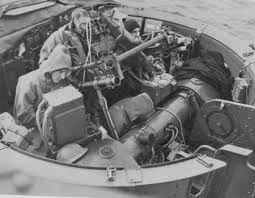
And this inability or reluctance to change doctrine, it should be remembered, was not just something related to the American-built and supplied Escort Carriers which just happen to be the most glaring and public examples. For instance, did the few feet added aft (basically a round-down) to the flight deck by Burrards in Canada really make such a huge difference – especially when the Escort Carrier only was used to ferry aircraft? Did single 20mm Oerlikons have to be replaced by power-operated twin Mk V models? I can understand modifications made, for instance, if racks made for US torpedoes will not accept British ones but this sort of modification is minor and should be capable of being fixed easily. Obviously, there was a fundamental disagreement on aviation fuel stowage and handling. However, in the final analysis, how many USN Escort Carriers were lost due to aviation fuel accidents? None. Of the ones lost in action, only the detailed after-action reports would reveal if any particular deficiency led to a premature end. However, with the massive explosions such as occurred with kamikaze hits it would be impossible, I believe, to say that the difference between an Escort Carrier like St. Lo, Gambier Bay, Ommaney Bay or Bismarck Sea being lost or saved was due to their aviation fuel arrangements. That they withstood such severe damage for as long as they did with raging fires from their own burning aircraft is testimony to their integrity and the courage and training of their crews in damage control. But, of course, the same could be said of the torpedo damage sustained to HMS Nabob and HMS Thane, both of which just might not have made it back to harbour had it not been for some of the extra measures taken post-handover. Whatever they were, and whatever part they did or did not play in preventing these Escort Carriers from sinking, they certainly never saw action again and were declared total constructive losses.
Now I think we need to come to the “bang for your buck” equation.
We know that US-built Liberty ships and US-built Escort Carriers consumed more manhours than the British-built equivalents. This was the price to be paid for speedy production. Of course, they cost more too especially considering the disparity in cost per man-hour. But what was more important? Cost or time? Was getting something into action quickly but expensively more important than getting it into action slowly but cheaply? I think the answer to that is clear – providing you have deep pockets. America did. Britain did not. In fact, Britain was running on credit. Its gold reserves were exhausted – hence Lend Lease and other more conventional credit arrangements that Britain was forced to enter. However, given that, as someone who spent a lot of his professional career engaged in what I called “value engineering” with regard to construction and property development, I could not help but look at the British-built Escort carriers, and the MACs, and see what I thought were extravagances that could have been avoided, corners that could have been cut to reduce the cost of materials and the labour associated. I raised these issues with what I termed HMS Austerity and again concerning the MACs.
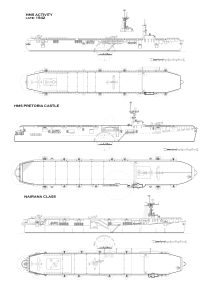
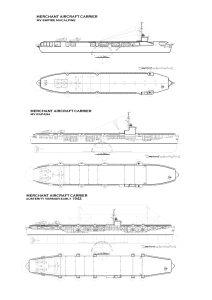
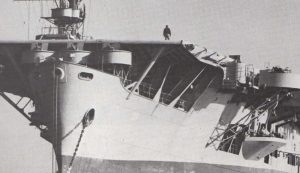
Why weren’t the British-built Escort Carriers built to a more austere design that made better use of the limited material and manpower resources? Was this a case of pigheadedness? Was it a case of inter-navy jealousy? Was it bred from some sort of, we-know-what’s-best-for-us mentality? Or, was it more a case of old dyed-in-the-wool practices that started in the draughting offices, a methodology that started on the drawing board and could not and would not change and followed through all the way to the shop floors with demarcation disputes as to who was allowed to do what, when and how? Reality did prevail, however, in the case of the Loch-Class frigates – the follow-on class from the River-Class – and the Castle-Class corvettes – the follow-on class from the Flower-Class. In the Lochs, the sheer was reduced to three straight lines and the curves at the stern were reduced to a simple, straight transom. In the Castles, the same principles were brutally applied and the transom stern must have saved a lot of time and materials. Transom sterns weren’t by any means new. They had been a feature, if you could call them that, of some of the emergency standard merchant ships of World War I when Harland and Wolff, hardly the first name that comes to mind as radical ship designers and builders, came up with the National or N Class which was a no-frills, straight-sided, flat-bottomed design with hard chines and no rounded steel plates or other refinements whatsoever – all in the name of fast production. Yet, all of the British-built Escort Carriers, and all of the MAC ships look like they were designed and built as though they were meant to be examples of the best of British peace-time ship design and shipbuilding practice. Look, for example, at the photograph of HMS Pretoria Castle and note the way in which the flight deck has been curved to match the shape and flare of the hull whereas the US carriers had parallel flight decks. Note the way in which the flight deck has been supported by being plated in with neatly mitred openings, or, worse, rounded openings. Why, for example, did they have steel flight decks when steel was in short supply? Not only did these cause sparks when a plane crash-landed increasing the risk of sparks, but holding-down lugs had to be (preferably) recessed – another time-consuming activity – or proud of the deck and therefore a hazard. Note the way in which the sponsons are rounded and moulded to fit the hull so elegantly. Note the hull openings for ship’s boats, all neatly mitred at the corners. From a value-engineering point of view, every one of these has cost more to achieve by way of time and materials than the more simplified approach visible in the US-built Escort Carriers. Or, indeed, to the very rudimentary Japanese carriers. But, to what end? Efficiency? No. Appearance? Well, yes – undeniably they look more ship-shape in the traditional sense of the word. They look like what a marine draughtsman would sketch up as a design proposal for a client wishing to make a good impression – in peace time!
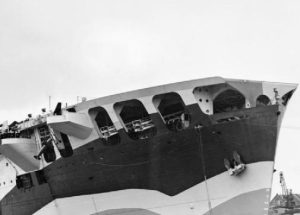
HMS Pretoria Castle’s bow. Notice how the flight deck area is reduced at the expense of fairing the deck to match the flare of the hull, plus the finessing of the hull openings and sponsons. All very ship-shape, but at what cost? [wikimedia]
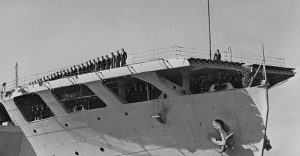
HMS Campania’s bow. Note too how the flight deck has been supported and the openings trimmed.
USS Santee displays a full width and cantilevered flight deck, much more simply but effectively supported, as are the gun sponsons. [www.navsource.org]
In 1896 the influential American architect Louis M Sullivan came up with one of the tenets of modern architecture that “form follows function”. That is, that how something looks is determined by how something works, not the other way around. Or put another way, more brutally; whatever it is that’s being designed has to “work” first, has to be fit for purpose first, and how it looks takes second place. The British marine draughtsmen seem to have got this the other way around. Form – how something looked – was more important than how it actually functioned or what it cost. So, why, for example, the “missing” flight deck area? Was this because the British carriers had less freeboard? Was the reduced freeboard because of the weight of the steel flight decks and the plating up of the hull sides?
But this wasn’t peace-time. These were emergency, get-the-job-done-and-get-it-done-quick times. Did no-one question the methodology? Did no-one ask: why are we still doing it this way? Perhaps, Britain simply could not adjust to changing circumstances and that is why it no longer has a significant shipbuilding industry.
There is also the vexed question of the use to which the Royal Navy put its escort carriers vis-à-vis the USN. In March 1943 a 12-day Atlantic Convoy Conference in Washington, DC, established a modus operandi that divided the Atlantic into two zones of responsibility: the USN to handle the Central and Southern Atlantic convoys and the RN and RCN to handle the North Atlantic Convoys. While it also settled schedules, expanding the HF/DF network and other issues regarding more efficient operations what was most significant was that each force was free to organise its operations in whatever manner it believed was most suitable or efficient for its purposes. And, in this respect, this is where the use of Escort Carriers differed.
The Admiralty policy was to operate the Escort Carrier in close support of the convoy under the close tactical control of the Admiralty. In the case of the MACs, they were always within the body of the convoy itself. Launching and retrieving aircraft required the Escort Carrier (or MAC) to turn head-to-wind – particularly in the absence of catapults – which might be completely the opposite direction in which the convoy was sailing. Prevailing Atlantic winds are Westerly requiring an escort to accompany the carrier each time and a risky catch-up-and-get-back-into-position procedure. Manoeuvring within the convoy, in and out, was always risky, particularly at night, despite the most usual location of the carrier last in a near-to-centre file. Further, the patrolling role of the ASW aircraft – the Fairey Swordfish – was, generally, flown in set patterns (Adders, Alligators, Cobras, Crocodiles – refer Glossary) around and relatively close to the convoy designed to force U-boats to stay submerged so they could not move into position to attack the convoy. In some respects, one could define this as defensive posture but it was very much in line with the Admiralty policy of “the safe and timely arrival of the convoy” which was always the priority. Sinking U-boats was always regarded as a bonus.
The USN had a different view. It could afford to. It had more ships, more and better aircraft, more men, more fuel to expend. At first it favoured a method the RN had tried, when the assets were available, of operating an Escort Carrier with appropriate escorts near to the convoy but close enough to provide the necessary ASW cover. In May 1943, the month that co-incidentally marked the change of tide in favour of the Allies in the Battle of the Atlantic, the USN’s Vice-Admiral R.E. Ingersoll stated “…decided that close air support of central trans-Atlantic convoys was a waste of effort; that it would be better to leave the commanders of escort carrier groups complete discretion to hunt down submarines where HF/DF fixes indicated…” [1] This progressed to an aggressive approach for “hunter-killer” groups of one Escort Carrier and several old destroyers (later new escort destroyers) to loiter in and patrol the areas of the Central and South Atlantic from where ULTRA or HF/DF intelligence originated and where the Task Group commander had complete freedom of action to pursue any contact to whatever degree he felt appropriate. The results spoke for themselves.
However, trans-Atlantic acrimony continued. The former commanding officer of the successful USS Core attended a conference in England in October 1943, specifically regarding Escort Carrier ASW operations, and reported on his return his opinion of RN Escort Carriers, inter alia:
“It is my belief that the carrier squadrons are being well trained but that due to inexperience the inability of the officers to efficiently operate the carriers is deplorable, even though the young captains in command are, and have been, exceptionally fine young gunnery and submarine officers; and I now can better understand why it is necessary to run the carriers from Headquarters ashore like a puppet show instead of giving them complete freedom of action which we are successfully employing. It is my opinion that we must continue to accept the unpleasant truth that we can not expect much from British CVE’s in the antisubmarine warfare in the near future. This, to my mind, results directly from the fact that they have not had our fortune of able leadership in Naval Aviation.” [2]
Ouch!
I have no axe to grind and try to take an unbiased outlook. To say that one approach was more successful than the other would be to make an unfair and unbalanced judgement. One would not be comparing apples with apples. For a start, the convoy routes were different and subject to different traffic and different pressures. The timing was different. The peak was over. The best of the German U-boat skippers had been lost. The Allies’ equipment was different. But, probably and most importantly, their resources were different. When the tide changed in May 1943, Britain had been fighting the Battle of the Atlantic for 3 ¾ years on its own and for almost 1 ½ with American assistance. It simply did not have the luxury of being able to create the USN sort of “hunter-killer” groups with Escort Carriers, although it did manage to create specialised Escort and Support Groups which operated independently of, but in co-operation with, convoys – sometimes with Escort Carriers. Indeed, the very first support groups, which might be termed “hunter-killer” groups, were the 4th and 5th Support Groups formed around the Escort Carriers HMS Archer and HMS Biter with destroyers in late April 1943. Despite on-going problems with Archer’s propulsion which shortened her career in August, her aircraft sunk U-752 on 23 May 1943.
Having made the point that there was a discrepancy of resources, a critic might well raise the point: what about all those US-built Escort Carriers? What was the RN doing with those? Well, let’s look at what was commissioned and when and which ships were doing what, and when. At the time the decision was made – referred to above – in March 1943, the RN had;
- Archer (commissioned November 1941) – starting duty as 4th Support Group.
- Biter (commissioned May 1942) – starting duty as 5th Support Group.
- Activity (British-built, commissioned September 1942) – Deck Landing Training.
- Attacker (commissioned October 1942) – on delivery voyage, convoy CU 1, Curacao to Liverpool.
- Battler (commissioned October 1942) – at Harland & Wolff, Belfast undergoing modifications.
- Stalker (commissioned December 1942) – on convoy UGS 6 carrying US aircraft to Casablanca.
- Hunter (commissioned January 1943) – on convoy UGS 6 carrying US aircraft to Casablanca.
- Tracker (commissioned January 1943) – on passage, Seattle to New York.
- Fencer (commissioned 1 March 1943) – in San Francisco.
The following month a further three American-built Escort Carriers were commissioned into the RN, one each for the next three months (plus British-built Pretoria Castle), then six in August, two in September, two in October, four in November (plus British-built Nairana & Vindex) and another three in December to see out 1943.
However, looking at the list of the six American-built Escort Carriers, above, that were commissioned late in 1942, what is painfully clear – and what was a bone of contention with the Americans generally – was the long delay between commissioning and putting the carriers to actual use. Look at HMS Attacker, for example, which did not arrive in Britain until 4 April and then underwent a two-month period of “modification”! Similarly, HMS Battler did not leave Belfast’s docks until 4 April. HMS Stalker and HMS Hunter were at least active even if it was at the bidding of the United States – and not unreasonably so given the circumstances – delivering their aircraft to North Africa. That was the least they could expect from what seemed on the face of it a tardy response to being given – well, loaned in the strict sense of the word – the Escort Carriers in the first place.
The busiest months for the USN’s “hunter-killer” groups were July 1943 (4 U-boats), August 1943 (5 U-boats) October 1943 (6 U-boats). Let’s look at what the RN’s Escort Carriers were doing in, say, the middle of that period – September;
- Archer (commissioned November 1941) – out of commission due to machinery defects.
- Biter (commissioned May 1942) – with 5th Support Group, convoy defence.
- Activity (British-built, commissioned September 1942) – Deck Landing Training.
- Attacker (commissioned October 1942) – with TF 88 providing air cover for Operation Avalanche.
- Battler (commissioned October 1942) – with TF 88 providing air cover for Operation Avalanche.
- Stalker (commissioned December 1942) – with TF 88 providing air cover for Operation Avalanche.
- Hunter (commissioned January 1943) – with TF 88 providing air cover for Operation Avalanche.
- Tracker (commissioned January 1943) – began convoy escort with Canadian Escort Group 4.
- Fencer (commissioned 1 March 1943) – with 8th Escort Group.
What is obvious is that compared with the March 1943 time frame, the RN’s Escort Carriers were being put to good use (save the defect-plagued Archer) and that the new additions were “in action”. Ships commissioned since then were;
- Searcher (commissioned April 1943) – in Liverpool being fitted out as Fighter Carrier.
- Chaser (commissioned April 1943) – at Rosyth under repair after boiler room explosion.
- Ravager (commissioned April 1943) – Deck Landing Training.
- Striker (commissioned May 1943) – at HM Dockyard Chatham for modifications.
- Pursuer (commissioned June 1943) – at Liverpool being fitted out as Assault Carrier.
- Ameer (commissioned July 1943) – at HM Canadian Dockyard, Esquimalt for modifications.
- Pretoria Castle (British-built, commissioned July 1943) – undergoing trials.
What is also obvious from these additions is the RN’s penchant for making changes or upgrades; four in dock, repairs to another in dock due to a boiler-room explosion, one more being used for Deck Landing Training – a necessary role – and one undergoing what seemed to be very prolonged trials.
Ships all commissioned just the month before and but still in HM Canadian Dockyard, Esquimalt for modifications Canada were; Begum, Trumpeter, Emperor*, Slinger, Empress and Khedive.
Footnote: *HMS Emperor ended up with eight Battle Honours: ATLANTIC 1943-44 – NORWAY 1944 – AEGEAN 1944 – NORMANDY 1944 – SOUTH FRANCE 1944 – MALAYA 1944 – EAST INDIES 1945 – BURMA 1945
As David Wragg says:
“The British habit of refining the CVEs sent to them by the US Navy caused considerable irritation, as the Navy estimated that there were delays of between twenty-four and thirty weeks between delivery of a ship to the Royal Navy and its operational availability. Not only did the Royal Navy not like the layout of the fuel system and also objected to using sea water as compensation for spent fuel, they also preferred to ballast the ships, further reducing fuel capacity. The way in which the hulls of the escort carriers were broken up into watertight compartments was also regarded as being below British Standards. One result was that the Americans reproached the British for mainly poor use of escort carriers supplied at some sacrifice to their own interests. The question was, of course, whether the risk to the crews of the carriers or the risk to merchant shipping and escort vessels on the convoys lacking air cover was the greater.” [3]
With regard to the way in which the Escort Carriers were used in the Atlantic, who is to say whether the British approach was wrong and the American approach was right – or vice versa. Was it that critical, in the USN eyes, that every U-boat that was simply driven away from a convoy was free to try again but every one sunk was one less to try again? Or, was the better objective to simply get the convoys to their destinations, come what may; that it really didn’t matter in the end if U-boats survived providing the convoys did? I must admit I am inclined to subscribe to that concept, that the volume of the logistics delivered, the materiel to sustain war and the people who wage it would eventually be the determining factor, not the enemy’s submarine losses. Professor A. J., Marder in his 5-volume work, From the Dreadnought to Scapa Flow, believed that sinking submarines was a bonus and that what mattered was that ships delivered their cargoes regularly and adequately, that it did not matter how many submarines the Germans had providing they were forced to keep out of the way and the ships got through without being delayed by fear of attack. [4]
Either way, the combined efforts of the Allied navies worked and the U-boats were defeated and the Battle of the Atlantic was won. That Escort Carriers, whether in the RN or USN, played a significant role is beyond dispute.
- Samuel Eliot Morison, History of United States Naval Operations in World War II, Volume 10, The Atlantic Battle Won, May 1943-May 1945, p.110
- uboat.net
- David Wragge, Escort Carriers of the Second World War: Combustible, Vulnerable & Expendable, 30
- John Terraine, Business in Great Waters: The U-Boat Wars 1916-1945, 87