In short, HACS was the answer – in theory if not in practice – to the problem of controlling a ship’s anti-aircraft fire successfully against attacking aircraft. That is, to predict when and where to fire anti-aircraft weaponry in such a way that projectile and aircraft arrive at the same place in the sky at the same time. Pre-war, the RN regarded bursts within 100 feet (33 yards) as being ‘effective’, but post-war experiments showed a 4in shell bursting at 45 feet (15 yards) only had a 15 per cent chance of a kill, over quite narrow zones.
However, since it proved ineffective unless it was used against relatively slow-moving aircraft that maintained a steady speed in a steady direction at a steady altitude and consumed prodigious amount of ammunition in order to do so, HACS was only the answer to that problem.
Even so, it was found unable to shoot down a (slow) Queen Bee drone unless copious amount of ammunition was used.
So, when was HACS developed, how did it work and what alternatives could have been adopted in its place?
The development of HACS dates back to 1919 when the Naval Anti-Aircraft Gunnery Committee (NAAGC) was established. But it took until January 1930 for the first set to be trialled. No less than 12 other predictor schemes were rejected and the Tachymetric System Mk 1 (TS 1) was, unfortunately abandoned. Tachymetric systems generate target position, speed, direction, and rate of target range change, by computing from continuous measurement input, usually from gyro-based instrumentation. Gonometric, or Goniographic, systems such as HACS were used to estimate lateral and vertical defections and rely on an initial input of estimated data and range change rate was tachymetric. While HACS was in some respects innovative, for its time, it relied on too many estimated inputs especially when aircraft performance and tactics improved.
HACS had several innovative features, but relied on a number of estimated inputs. These shortcomings were cruelly exposed as target speeds increased, and the attack trajectories changed.
It relied on observed estimates of speed, direction and altitude being entered into a computer which then analyses the observations and generates data as to change of bearing and range which is passed back to the observer who corrects the estimate against his optical sights to stay on target.
The second NAAGC was between 1931-32 and this evaluated the many ad-hoc type modifications to what was HACS Mk I. NAAGC analysis showed the benefits of tachymetric compared to goniographic systems, but that the Admiralty – still with a “Big Gun” mentality – failed to predict the growth in aircraft capabilities.
HACS was based on the premise that the target moved at a constant course, speed and height throughout the engagement. The system was goniographic for lateral and vertical deflections, but also used range rate (a tachymetric process):
- Goniographic (or goniometric) prediction used estimated inputs based on a series of discrete measurements of the target position.
- Tachymetric prediction used continuous measurement of actual target rates, typically using gyro-based instruments.
HACS was about one-third tachymetric, but its solutions were only approximate; performance depended on the Control Officer correcting the fire, based on the position of the earlier bursts with respect to the target, assuming this did not alter course/speed/height, or ‘jink’; in many cases this only achieved ‘harassing fire’.
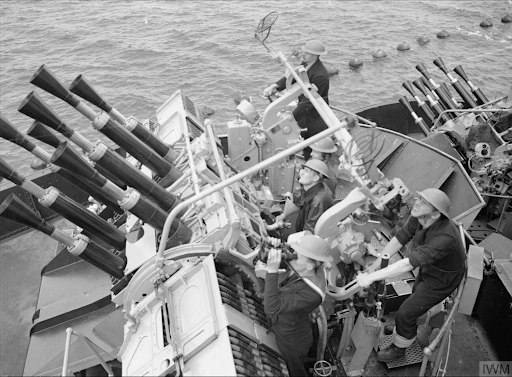
The constraints were that the hand-driven HACS director weighed several tonnes, most were not stabilized, optical ranging was difficult, and data feeds relied on somewhat unreliable ‘step-by-step’ transmissions. The below-decks crew followed input pointers to set the table, leading to lagging errors against crossing targets, and there was no power drive for the gun mountings.
[Source: www.navweaps.com]