

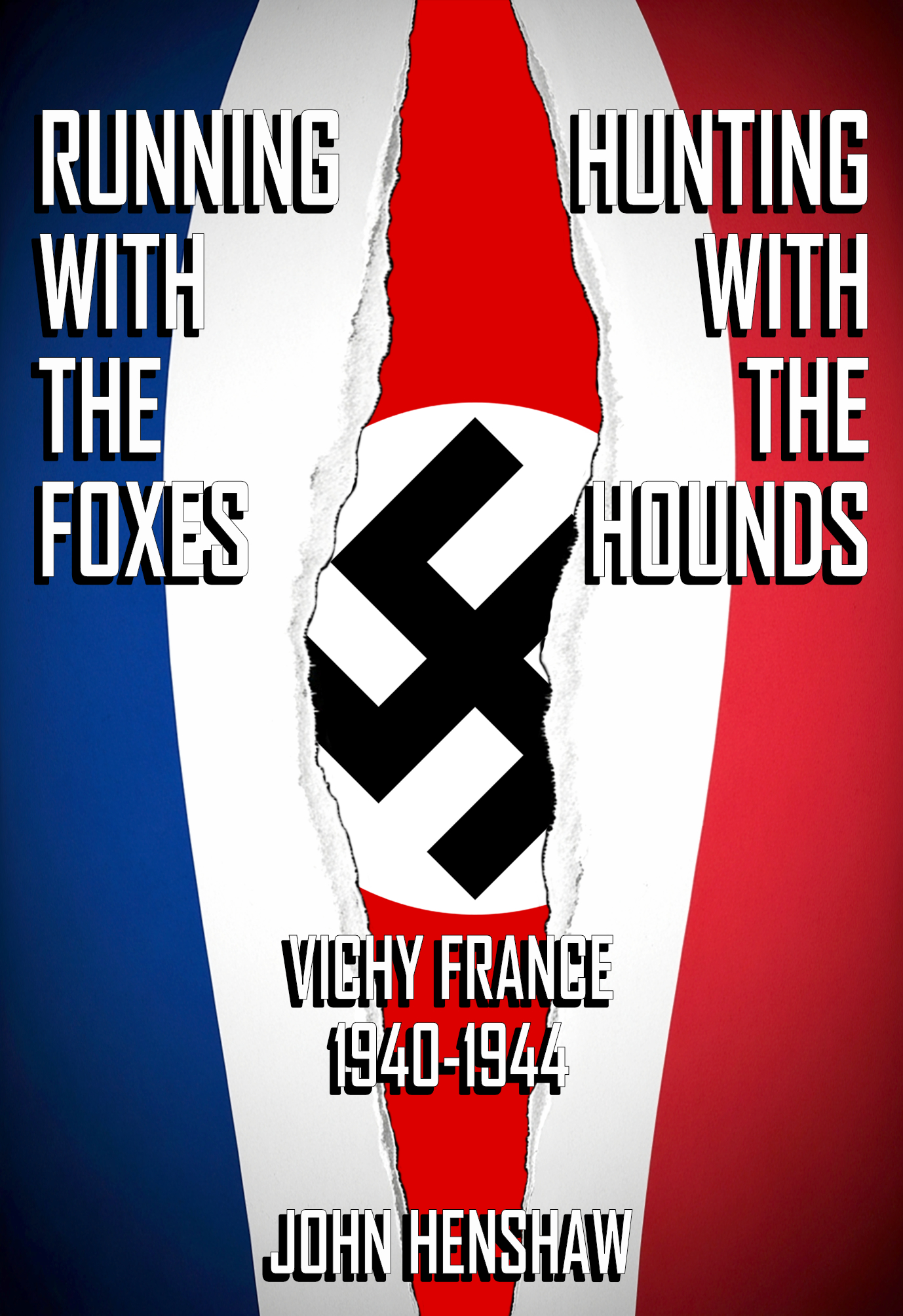
Twice in the last century, the British shed blood to defend France from aggressors. So, why does a defeated nation side with its conquerors and take up arms against an ally who so recently fought side-by-side with them as brothers-in-arms?
That question always bothered me whenever I read anything about theoretically neutral Vichy France (Régime de Vichy) which existed between10 July 1940 and 9 August 1944. One of the issues I found hard to get my head around was the role that Vichy France played in the Mediterranean Sea in particular. My interest was piqued when I was undertaking my research for MALTA’S SAVIOR: Operation Pedestal, August 1942. [i] For example, a Vichy-flagged merchant ship steamed straight through the huge Malta-bound convoy as it passed through the Strait of Gibraltar at night and an Algiers-bound Air France flight reported sighting the convoy, both reporting and thereby making public its position, course, and speed.[1]Then there was the turning of a Vichy blind eye to the passage through the Rhine-Rhône canal system of the S-39 Class German E-boats (Fast Boats-Schnellbooten) to the Mediterranean which were used successfully against the convoy in Vichy-controlled waters. [2] Also, allowing the use of Vichy airfields in the Levant to permit the transfer of Luftwaffe aircraft to anti-British forces in Iraq?
Why would one aid and abet a long-standing enemy?
Didn’t the War of 1870 which saw the Germans occupy Paris, the Great War 1914-1918 when the Germans almost reached Paris and the fact that after a campaign lasting only six weeks the Nazi flag now flew from the Eiffel Tower stir a nation-wide resentment, a will not to buckle under a foreign foe? What was it about the French people that could divide them into acceptors, collaborators, and resistors: those who simply accepted the regime as an inevitability, those who collaborated with the Nazis because they shared the same ideology and those who resisted the Nazis and everything they stood for? How did this happen? What were the consequences?
That interest grew when I decided to learn more of the wider role played by neutral Vichy France and, particularly, the instances when its forces came into conflict – direct and indirect – with Britain and its empire, initially, then with the Western Allies, because there were examples of passive acquiescence at best, and armed collaboration at worst.
So, I went back to the basics: how, when and why did Vichy France exist in the first place?
The ink was barely dry on the Agreement of Mutual Assistance signed on 25 August 1939 between Britain, France and Poland, pledging assistance in case of military aggression by a foreign power, when the Germans invaded Poland on 1 September 1939. Britain, then France, declared war on Germany (not the other way around) on 3 September but did nothing material to assist Poland. Geography stood in the way. Poland, east of Germany, was simply too far away from the nearest British and French territories and aircraft of the time did not have the range to avoid German air space and deliver direct assistance. Any overland incursion was impossible. France and Britain chose to go to war and the best that could be offered was the French incursion into part of the Saar area of Germany’s western front on 7 September. A German counter-offensive of 16 October forced a withdrawal. On 17 September, the Soviet Union added to Poland’s increasing woes and invaded from the east. Caught in a pincer movement between two powers of diametrically opposed doctrines – save for land grabs – Poland was doomed.
The eight-month “Phoney War,” “Drôle de guerre” or “Sitzkrieg” existed until 9 April 1940 when Denmark and Norway were invaded followed on 10 May 1940 with the German invasion of France and the Low Countries (Belgium, Luxembourg, and the Netherlands). This brought the British Expeditionary Force (BEF) – almost 400,000 strong which included 10 infantry divisions – plus the British Air Forces in France (BAFF), into action alongside their erstwhile brothers-in-arms, the French, and Belgians. Six weeks later the Battle of France was over. The Allies were out-manoeuvred by a Wehrmacht fighting a “different” type of war than was expected, termed, conveniently if not accurately, a “Blitzkrieg” (lightning war) – that is, the application of combined arms such as infantry, tanks, aircraft, and artillery in a mobile assault along a narrow front aimed at driving a breach in enemy defences. This allowed armoured forces to penetrate deeply and rapidly behind enemy lines, often culminating in pincer or encircling actions. That France lost the battle, was unable to counter the German offensive, was due mainly to three interconnected factors: an intelligence failure, operational and tactical inferiority, and poor strategic leadership. But, underpinning this, or more particularly undermining the German invasion, was a general malaise on the part of the French population characterised by a profound sense of defeatism – ce qui doit arriver arrivera (loosely; what will be, will be)
The terms of the Armistice signed on 22 June 1940 between France and Nazi Germany, and effective on 25 June, established a Zone Occupée (Occupied Zone) in the northern part of France and a Zone Libre (Free Zone) in the south – the border or Demarcation Line being specified in the Armistice. It ran from the Spanish border close to the Bay of Biscay, north and east to near Tours then south and east towards Switzerland to Alsace-Lorraine (which the Nazis annexed) then south to near Geneva. Italy had also annexed a small section along the Italian border in south-east France. However, the armistice somewhat unusually allowed France to keep her overseas territories, protectorates, and colonies together with her fleet. Article IV of the Armistice provided for the creation of the. Armistice Army of Vichy France (Armée de l’Armistice) to keep internal order within the Free Zone and her overseas possessions and to defend against assault, presumably by enemies of Germany.
Unlike the Poles, the Dutch and the Norwegians, for example, instead of maintaining a legitimate government in exile in, say, French North Africa – which was a distinct possibility had the heart been willing – the French government simply re-established itself in the German protectorate at Vichy with Marshal Philippe Pétain as the Chief of State. On 10 July the French parliament, the National Assembly, voted 569 to 80 (with 18 abstentions) to abandon the Third Republic: (born 4 September 1870 after the French defeat at Sedan, died 22 June 1940) and give Pétain full and extraordinary powers including a new constitution. This never eventuated. Pétain’s popularity – The Lion of Verdun, stemming from World War I – gave the Vichy government a legitimacy that some historians dispute. However. over 40 countries came to officially recognise Vichy thereby supporting its legitimacy.
France’s apparent willingness to exist within a Fascist regime is exemplified by the fact that of some 123,000 French servicemen who were rescued from Dunkirk, plus those already in Britain (such as wounded, convalescents, merchant seamen) and some 7,000 French navy personnel) all bar 3,000 elected to be repatriated via being granted safe passage to France or French territories and to live under Nazi rule. Of the 500 officers and 18,000 sailors of the French Navy in Britain in 1940, 450 officers and 17,800 sailors chose to be repatriated rather than fighting for their country with Brigadier-General (Général de Brigade) Charles de Gaulle.[ii] Hardly a ringing endorsement of the concept of a Free France.
The nascent Free French movement under (then) de Gaulle’s “call to arms” of 18 June 1940, via the British Broadcasting Commission, pre-dated the Armistice and was a call to continue the struggle, to maintain France’s national honour and freedom.
Translated it read:
The leaders who, for many years, were at the head of French armies, have formed a government. This government, alleging our armies to be undone, agreed with the enemy to stop fighting. Of course, we were subdued by the mechanical, ground and air forces of the enemy. Infinitely more than their number, it was the tanks, the airplanes, the tactics of the Germans which made us retreat. It was the tanks, the airplanes, the tactics of the Germans that surprised our leaders to the point to bring them there where they are today.
But has the last word been said? Must hope disappear? Is defeat final? No!
Believe me, I speak to you with full knowledge of the facts and tell you that nothing is lost for France. The same means that overcame us can bring us to a day of victory. For France is not alone! She is not alone! She is not alone! She has a vast Empire behind her. She can align with the British Empire that holds the sea and continues the fight. She can, like England, use without limit the immense industry of the United States.
This war is not limited to the unfortunate territory of our country. This war is not finished by the battle of France. This war is a world wide war. All the faults, all the delays, all the suffering, do not prevent there to be, in the world, all the necessary means to one day crush our enemies. Vanquished today by mechanical force, we will be able to overcome in the future by a superior mechanical force.
The destiny of the world is here. I, General de Gaulle, currently in London, invite the officers and the French soldiers who are located in British territory or who would come there, with their weapons or without their weapons, I invite the engineers and the special workers of armament industries who are located in British territory or who would come there, to put themselves in contact with me.
Whatever happens, the flame of the French resistance must not be extinguished and will not be extinguished.
In addition, a poster was widely distributed – the so-called London Poster on 5 August 1940 which read:
TO ALL FRENCHMEN..
France has lost a battle?
But France has not lost the war!
A makeshift Government may have capitulated,
giving way to panic, forgetting honour, delivering
their country into slavery. Yet nothing is lost!
Nothing is lost, because the war is a world war.
In the free universe immense forces have not yet
been brought into play. Some day these forces will
crush the enemy. On that day France must be present
at the Victory. She will then regain her liberty
and her greatness.
That is my goal, my only goal!
That is why I ask all Frenchmen, wherever they
may be, to unite with me in action, in sacrifice and
in hope.
Our Country is in danger of death. Let us fight
to save it.
LONG LIVE FRANCE!
General de Gaulle [3]
Headquarters,
4, Carlton Gardens
London, S.W. 1
De Gaulle had been undersecretary of war in the fallen Reynaud cabinet and 10 days later de Gaulle was recognised by the British government as the leader of the Free French – a somewhat different recognition than that offered to the legitimatized governments-in-exile in Britain for Belgium, the Netherlands, Norway, and Poland. He formed the French National Committee (Comité National Français) in 1941, for which he boldly claimed the status of a legal government-in-exile. De Gaulle was struck off the Army List on 23 June in retaliation by the French cabinet.
Initially, de Gaulle attracted only a handful of exiles to the cause, those who happened to be in Britain at the time, despite the attack on the Vichy-leaning French fleet at Mers-el-Kébir on 3 July 1940, it was to Pétain, rather, that most of the nation looked to for salvation because heroes are trusted. Likewise, the French overseas territories did not rally to the call and tended to accede to the wishes of the newly established Vichy government.
De Gaulle realised that simply being a voice based in Britain and remote from French territory was not going to exert the influence necessary to be taken seriously as an effective ally of the British. What was needed was some sort of demonstration in a non-mainland part of the French empire in support of the Free French movement. That came soon enough when the remotest of all outposts, the Franco-British condominium of New Hebrides (18 July), New Caledonia (20 July) [4] followed by Tahiti (31 August), Oceania (2 September), the trading outposts of the French East India Company (Pondicherry, Mahé, Karikal, Chandernagore, and Yanaon, (19 September) declared themselves for de Gaulle. But these were Pacific and Indian Ocean territories, far removed from the European theatre. What de Gaulle needed was territory that, even remotely, could be used as bases to counter Axis influence and expansion. In the first instance, this was Chad, a land-locked French colony and together with French Congo and Ubangi-Shari formed French Equatorial Africa (Afrique équatoriale française). Chad bordered Libya to the north and, thereby, in direct contact with the Axis partner, Italy. On August 26 1940, Chad declared for de Gaulle and the next day Cameroon followed. On 29 and 30 August, the Middle Congo and Ubangi-Shari rallied to Free France. In Equatorial Africa, only Gabon – wedged between Cameroon and Middle Congo – could not be moved, remaining loyal to Vichy. While its allegiance to the Free French had been pledged by the governor on 28-29 August, it was rescinded after opposition led primarily by the Catholic bishop for Libreville who favoured the Vichy policies. Such a display of disunity in the area was not to be tolerated and de Gaulle went to Cameroon on 8 October to rally support. The indefatigable Colonel Philippe Leclerc [5] led a small force in what became known as the Battle of Gabon – 27 October-12 November – and Gabon was returned to the fold. Leclerc then used Chad as a base to begin offensive operations in Libya.
De Gaulle had less success, perhaps less interest, in French possessions in the Caribbean and on the north-west coast of South America. On 24 December 1941, Free French ships landed a small force and took control of Saint Pierre and Miquela. The island of Martinique, where substantial French gold reserves had been sequestered, was the enforced home to the aircraft carrier Béarn and the light cruiser Émile Bertin. It was not 6 July 1943 that Martinique changed allegiance to the Free French. French Guiana – sandwiched between Dutch Guiana to the west and Portuguese Guiana to the east – also changed allegiance, on 16 March 1943.
But what of the overseas territories that stayed loyal to Vichy?
The Vichy regime put up a strong resistance in June 1941 when the British invaded Vichy-controlled Syria and Lebanon in order to prevent the Germans from using this territory to attack Egypt. I remembered that an uncle had fought with the Australian 7th Division against the Vichy French in Syria and Lebanon in mid-1941. Unfortunately, I never asked why he had fought the French (as a forward artillery observer I recall) when he was still alive simply because I knew nothing of the conflict at the time. Perhaps that is partly explained by the 7th’s nickname – “The Silent Seventh” – because so little publicity was given to the campaign. [6] Similarly, the invasion and occupation of the island of Madagascar in May 1942 (Operation Ironclad) when a possible Japanese incursion made this island and its harbour of Diego-Suarez a target. Under these circumstances, was Britain guilty of attacking a neutral country? Probably no more-so than the controversial Mers-el-Kébir episode or the invasion of Syria-Lebanon in 1941.
The Vichy regime in Indo-China allowed Japan – a member of the Tripartite Pact – to occupy French Indo-China in late September 1940. Therefore, when does a nation’s neutrality end and collaboration – whether it be passive or active – take precedence? When does allowing a foreign country – albeit the one in effect controlling you – to use your territory to wage war against its enemies not constitute a breach of neutrality or give cause for that enemy to breach the neutrality? I studied law in the 1960’s and I don’t recall the subject of Public International Law covering this sort of issue.
In November 1942, when Operation Torch commenced, the Vichy French put up a spirited resistance knowing full well the intention of the invading force – to act as the western pincer complimenting the 8th Army’s eastern pincer in the campaign to drive the Afrika Korps out of North Africa. Thankfully, that resistance did not last long.
In theory, but not in practice, Vichy France was a sovereign entity and was neutral. In practice, it was a puppet state, a vassal, of Germany and its neutrality was – well, let’s say it was flexible and was whatever it deemed appropriate as and when circumstances dictated. In colloquial terms, Vichy France ran with the foxes and hunted with the hounds. In November 1942, after the Operation Torch landings in French North Africa, German and Italian forces invaded the Free Zone, disarmed the Vichy militia and sought to take possession of what remained of the French fleet in French ports. Unlike the episode at Mers-el-Kébir on 3 July 1940 when the Royal Navy gave the French the choices of joining forces with Britain, sailing to a neutral port to be disarmed or scuttling the ships, this time the French – well aware now that the pendulum had swung in the Allies’ favour – changed horses and chose to show some resistance to the occupying force by scuttling most of the warships. The two zones were then named Zone Nord (North Zone) and Zone Sud (South Zone) until October 1943 when the term Zone Occupée applied to the whole of France.
The Vichy regime ended on 9 August 1944 when the Provisional Government of the French Republic re-established republican legality and declared that all constitutional acts, legislative or regulatory and decrees to implement them by the Vichy government were null and void. Part of that “re-establishment” was the purging of Nazi collaborationists with summary and official execution figures running into a low of 10,000 and a high in excess of 100,000 persons. However, it would seem, that irrespective of the number of executions, there was a very fine line between what did and what did not constitute collaboration.
The reasons for what can best be described as the Vichy French attitude to neutrality are manifest and complicated. Unfortunately, there is no one-size-fits all explanation. This book examines what I believe was an impossible neutrality.
[1] Footnote: The British used numerous ruses de guerre. French North African territorial waters were used blatantly by individual Allied ships to and from Malta. Brisbane Star’s role in Operation Pedestal is noteworthy as was SS Empire Pelican and SS Empire Defender in November 1941 even using French and Spanish markings (in this case unsuccessfully!) as a ruse de guerre. Then there was the example of the fast minelayer HMS Welshman deliberately disguising its three-funneled appearance by placing French type caps on her funnels and painting the sides of her high freeboard and flush deck to try and appear like a French Chacal Class destroyer. Vichy French merchant ships made frequent and uninterrupted passages in and out of the Strait of Gibraltar as neutrals with the same immunity as if they had been Portuguese, Swedish, or Spanish.
[2] Footnote: The E-boats were disarmed, painted black for some reason and the crews were in civilian attire. Nevertheless, an obvious device to skirt the principles of neutrality.
[3] Footnote: De Gaulle used the title General (a 4-star rank) and not Brigadier or Brigadier-General (a 1-star rank) which was his actual rank.
[4] Footnote: This was not a straightforward declaration. There was considerable dissent, particularly in the administration. An effective Free French regime was not installed until 19 September after various political stand-offs and the threat of naval encounters between the Vichy Dumont d’ Urville and HMAS Adelaide
[5] Footnote: Full name Philippe François Marie Leclerc de Hauteclocque but adopted Leclerc as a nom de guerre to protect his family. As a three-star general he led the Free French 2nd Armoured Division to liberate Paris in August 1944 and was posthumously appointed Marshal of France in 1952. He had been killed in an air crash in 1947.
[6] Footnote: The 7th fought took part in the Siege of Giarabub (1940-41), the Siege of Tobruk (1941), the New Guinea campaign (1942-45) and the Borneo campaign (1945
[i]John Henshaw, Malta’s Savior: Operation Pedestal, August 1942, McFarland & Company, Inc., Jefferson, North Carolina, 2024.
[ii] Robert O. Paxton, Vichy France: Old Guard and New Order, 1940-1944, p.44