

When and where Soviet hegemony over Nazi-occupied Europe would have extended to the west in 1944-45 was dependent on two factors: first, how quickly the powerful Red Army tide would flood westwards, secondly, how effective would the anticipated Western Allies’ presence be in Western Europe to crush the Axis forces between the proverbial hammer and anvil. These would determine the future geo-political map of Europe.
Simply continuing, or even expanding, the Allies’ round-the-clock bombing of German industry and transportation networks was not going to free occupied Western Europe from Nazism and, simultaneously, deny it to Communism. Bombing was not going to change a regime. Bombing was not going to occupy territory. A blockade of the Axis powers – effective though it was in World War I against the Central Powers, Germany in particular – was not going to have the desired effect this time around. Worse, it would likely create even more problems in a post-war geo-political environment that was clearly going to be divided between the victors. There was a risk that without Western Allies’ boots on the ground, Europeans of many nations were simply going to exchange a Nazi yoke for a Soviet one.
The British were urged by Joseph Stalin as early as 18 July 1941 to open a Second Front to take the pressure off the Red Army. Stalin suggested invading the coast of German-held France and also in Norway – the last-mentioned leading to the tentative and somewhat hypothetical Operations Ajax, Marrow and Jupiter, all of which were abandoned at the First Quebec Conference in August 1943 in favour of Operation Overlord – “to secure a lodgement area on the Continent from which further offensive operations can be developed” [1]
The opening of a Second Front by the Western Allies in 1942 to divert no less than 40 Axis divisions as a matter of urgency from their Eastern Front, was an unreasonable ask, even beyond the rationale of the paranoid Stalin. Most of the now 2.2 million-strong British army was serving in the Middle east and Far East and the transfer of US troops to Britain had barely started. The number and quality of specialised amphibious assault vessels required for a cross-Channel invasion was woefully small. Further, they were untried – until Operation Jubilee, the ill-fated raid on Dieppe in August 1942. At great cost, the concept on storming a port and occupying it was proved to be not feasible. Conversely, the Anglo-American Operation Torch in November 1942 – the start of a Second Front in the eyes of the Western Allies but not in Stalin’s – involved three separate landings in French North Africa. The level of Vichy French resistance was meagre compared what could be expected in an attempt to breach Hitler’s Atlantic Wall and break into Festung Europa (Fortress Europe).
Operation Neptune was to be the amphibious assault of Northern France via five beachheads in Normandy – two American and five Anglo/Canadian: D-Day, 6 June 1944.
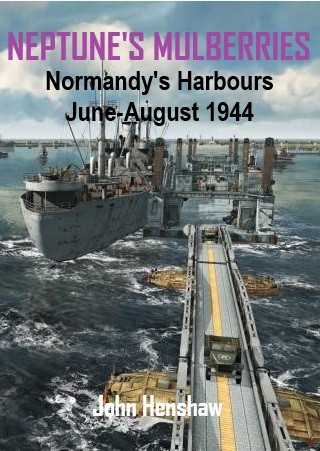
It occurred to me after the 80th anniversary of D-Day, that while Operation Neptune has been the subject of numerous written and visual works – some aspects of this momentous event have never been covered in the sort of detail presented in my other books; namely the narrative of the particular event and the various apparatuses of war involved, illustrated by technical drawings, ships in particular. And Operation Neptune, the naval phase of the over-arching Operation Overlord, possessed some very interesting material, indeed unique material, in this regard. Even the code-names of the numerous devices designed specifically to make D-Day possible added a certain level of intrigue of their own. Unassuming names like Beetles, Bombardons, Corncobs, Gooseberries, Lilos, Lobnitzes, Phoenixes, PLUTO, Rhinos, Spuds, SLUGS and Whales camouflaged the real purpose of these components. Despite the fact that the Daily Telegraph’s crossword of 21 May 1944 had a remarkable number of Neptune code words as answers to clues – purely coincidental as it turned out – the use of code words effectively hid, or at least confused, the way in which they were going to be used individually, collectively and synergistically and made possible the two artificial harbours, named Mulberry A and Mulberry B, and the World’s largest amphibious invasion in the history of warfare.
In order to put the D-Day invasion into context, Neptune’s Mulberries starts with a short examination of significant amphibious invasions. Since Britain is in one way or another the common denominator, Julius Caesar’s first expedition to Britain in 55 BC is the first mentioned. This was followed by his return visit in force the following year. After the Vikings – not one single invasion but a series of expeditions – came the next cross-Channel invasion, the Normans in 1066. Then we have another hiatus until the failed Spanish Armada of 1588. Moving away from British waters, the year 1741 saw a failed British amphibious operation against the Spanish at the Battle of Cartagena de Indias in New Granada. Four years later saw British success when Louisbourg, Nova Scotia, was captured from the French. Major General James Wolfe’s surprise amphibious landing at the base of the Plains of Abraham led to the capture of Quebec in September 1759. Then followed a succession of smaller amphibious operations: the year 1762 saw Havana, Cuba and Manila in the Philippines captured. Conversely, the British were unsuccessful in defeating an American amphibious raid on Nassau in the Bahamas in 1776. A Frano-Spanish bid to capture Gibraltar by water-borne forces failed in 1782 but a year later succeeded in capturing Minorca only to be recaptured in 1798. Napoleon Bonaparte’s planned invasion came to nought after the defeat of the Franco-Spanish fleet at the Battle of Trafalgar in 1805.
It took another 110 years before the next most significant amphibious invasion: the Churchill-driven plan to seize the Dardanelles via the disastrous Gallipoli campaign of 1915. The April 1940 Anglo-French landing, supported by Norwegian and Polish forces, attempting to seize the port of Narvik and seize Narvik and cut off the supply of Swedish iron ore to Germany was a failure mainly due to poor preparation and the failure to properly supply the force. Finally, Adolph Hitler’s intended Operation Sealion (sometimes referred to as Sea Lion), the cross-Channel invasion of Britain in the late summer of 1940 was thwarted by defeat in the Battle of Britain. These invasions and attempted invasions were all very different but each one larger, more complicated than the others, but all facing similar problems – the necessity to get ashore and, once there, to have overwhelming force to establish a lodgement to break-out of a beachhead and keep the invading force adequately supplied.
The background to 1944 is examined in order for the reader to have an appreciation of the significant military events leading up to Overlord. Rather than regurgitate the obvious, I have assumed that the reader is familiar with the first years of World War II: the invasion of Poland followed by a Phoney War or Sitzkreig then the invasion of Denmark, Norway, the Low Countries, Belgium, and France then the Battle of Britain. The year 1941 was particularly significant. June saw Hitler turn his attention eastwards with the largest ever military invasion, Operation Barbarossa, intended to subjugate the Soviets and provide Germany with Lebensraum (living space). Britain now had in the USSR an ally of sorts fighting a common enemy. The end of the year witnessed Japan’s surprise attack on America at Pearl Harbour, at one stroke changing the whole complexion of the conduct of the war. Britain now had another ally, one that – unlike the Soviets – shared common aims, objectives, and values. I then examine how Anglo-American cooperation ran parallel in some instances, diverged, came together, and diverged in different interpretations of the strategy needed to achieve victory. In particular, how, when and where the Allies would undertake the inevitable: put boots on the ground in Europe. The Americans, fresh to the fight with massive resources, wanted – indeed expected – an invasion somewhere in occupied Europe in 1942. Stalin, on the retreat until early 1943, demanded an invasion to divert the German offensive. Churchill, amateur soldier, professional politician, pushed for – and obtained – approval to attacking the Axis via a “soft underbelly” strategy and in doing so started the chain of amphibious landings leading up to Operation Neptune.
[1] Roland G. Ruppenthal in his book, Logistical Support of the Armies, Volume I: May 1941–September 1944 (page 178) has a slightly more nuanced definition: “The objective of the Overlord operation was not to bring about the defeat of the enemy in north-west Europe, but to seize and develop an administrative base from which future offensive operations could be launched.”