

Reviews
AUSTRALIAN NAVAL INSTITUTE
Reviewed by David Hobbs (January 31, 2026)
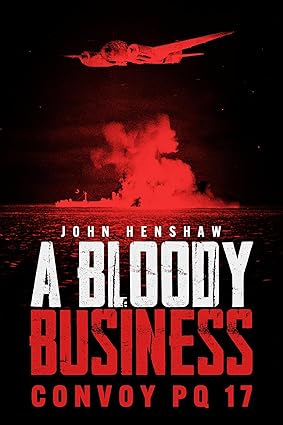
Australian naval historian John Henshaw is a prolific writer with a distinctive style that will have become familiar to ANI members as well as the wider international audience interested in the specific ships and events he has described. The stand-out features of his work are his own excellent line drawings of ships and aircraft.
In this instance there are 47 ship, submarine and aircraft drawings spread throughout the 171 pages of text supported by 75 carefully-chosen black and white photographs and two maps, all of which help the reader to form a very clear visual impression of the subject matter. I was delighted to see on page 10 that Henshaw refers to The Allied Convoy System 1939-1945published in 2000 by my friend and RN Historical Branch colleague, the late Arnold Hague, as the ‘most authoritative work on World War II convoys’; it would be my starting point for any study of a wartime convoy. Arnold Hague and American historian Bob Ruegg collaborated to produce an earlier book, Convoys to Russia 1941-1945, in 1999. Both are listed with other titles in this book’s bibliography.
Henshaw’s method is to study a wide range of secondary sources and then conduct a forensic, day-by-day analysis of the events identify errors and inconsistencies. Interestingly he found several, including RFAs intended to refuel escorts that were not, therefore, part of the convoy itself, ships that turned back for various reasons and genuine misunderstandings that must have been carried forward from errors in original source documents. This book’s title is drawn from the verbal message passed by megaphone from Commander Jack Broome RN in the destroyer Keppel who commanded the close escort to the convoy commodore, Dowding, shortly after the disastrous order from Admiral Pound, the First Sea Lord, that the convoy was to scatter, signalled at 2136 on 4 July 1942.
The text begins with a description of how the system of convoying war supplies to North Russia was established in 1941 before looking in detail at the disaster that befell PQ 17. A chapter is devoted to events in the Admiralty’s Operational Intelligence Centre in the hours before Admiral Pound decided, against advice, to order the convoy to scatter because he feared that the German battleship Tirpitz was about to attack it. In fact it was not close to the convoy although the order to scatter led to two thirds of the merchant ships being destroyed by aircraft and U-boats. The order to scatter PQ 17 meant that there was no need for Tirpitz to fight its way through covering forces to get at it and it returned to harbour well before ever reaching the ‘killing zone’. Subsequent chapters describe the aftermath, the successful passage of subsequent convoys and Soviet reluctance to acknowledge the valuable material assistance provided by their allies’ convoys.
As a single-point reference on the subject, this book stands out because of the quality of the drawings and images together with 33 pages of appendices which list every ship and aircraft type involved with lists of their technical details. Everything needed to understand the tragedy of PQ 17 can be found within this book’s covers, but it is only fair to point out that there is another recent book that covers PQ 17, inter alia. This is Andrew Boyd’s outstanding Arms for Russia & the Naval War in the Arctic which I reviewed for ANI at the end of October 2024. It has 500 pages of text, much of it reflecting the author’s extensive research into newly released primary sources in both Russian and western archives. Although it has a significantly wider focus it also devotes a chapter to the events in the Operational Intelligence Centre in the fatal hours before the signal to scatter PQ 17 was released and another on the catastrophe of the convoy’s destruction. As might be deduced from its primary title, Boyd describes the uses made by the Soviet armed forces of the material supplied by the allies and his book has, therefore, a significantly wider scope. John Henshaw and Andrew Boyd were probably writing at the same time without either being aware of what the other was doing.
John Henshaw’s A Bloody Business is focused on PQ 17 and his drawings help to create a book that, more than any other, makes the reader aware of the individual ships’ appearance and how they performed in this, the most difficult of situations. It is a concentrated source for ‘what, where and when’ data relating to PQ 17. There is, therefore, room on my bookshelf for A Bloody Business and I recommend it.
https://hmgs.org/blog/2025/12/26/a-bloody-business-convoy-pq-17/
Reviewed by Russ Lockwood
The West sent 41 convoys and 13 individual sailings to the USSR during the war. Of the 865 merchant ships, 728 arrived (15.84% loss rate), much higher than trans-Atlantic convoys (4% loss rate). Convoy PQ-17 suffered a 66% loss rate among the merchant ships (p xv).
The book contains a full OOB of Allied and German forces involved in the battle over PQ-17, along with specs of all ships. The preparation and sailing, defensive measures, and the attacks and scattering of the ships receive a detailed look. The biggest impact came with the British Admiralty decision to scatter the convoy upon reports that the battleship Tirpitz and escorts had sailed to intercept the convoy. It proved a fatal micromanagement of the convoy.
A nice recap of the action of German air and naval attacks allows you to set out a tabletop scenario or two. Certainly, a what-if scenario could include the Tirpitz and escorts actually involved.
The book contains 75 black and white photos, 106 black and white ship drawings (overhead and profile), and two black and white maps.
It’s a well-written book that dissects PQ-17 down to individual ships and attacks. Well done.
Enjoyed it.
Reviewed by Adam Makos
My name is Adam Makos, and I am a fellow author working in character-driven history. I recently learned of A Bloody Business: Convoy PQ 17, and I felt compelled to reach out in appreciation of the clarity and moral seriousness you bring to one of the most controversial naval episodes of the Second World War.
The Arctic convoys represent a uniquely harrowing chapter of the war where diplomacy, strategy, and survival collided in some of the most hostile conditions on earth. Your framing of PQ 17 within the broader arc of 1941–42 the shock of Operation Barbarossa, the entry of the United States into the war, and Churchill’s uneasy alliance with the Soviet Union grounds the convoy’s tragedy within the immense strategic pressures of the moment.
What stands out in your description is the disciplined dissection of events down to individual ships and attacks. By reconstructing the sequence from departure through the catastrophic order to scatter, you allow readers to see how decisions made far from the Arctic seas reverberated with lethal consequence. The fateful intervention of Admiral Sir Dudley Pound, contradicting staff advice amid fears of the Tirpitz, remains one of those moments where leadership, intelligence assessment, and human fallibility converge with devastating effect.
I particularly appreciate your inclusion of detailed appendices orders of battle, merchant ship listings, and German naval and air assets. That structural rigor signals a work designed not merely to recount events, but to serve as a definitive reference for students of naval warfare. Combined with narrative momentum, such documentation elevates the book beyond a retelling of tragedy into a careful examination of command, risk, and accountability.
The story of PQ 17 is painful precisely because, as you note, the scale of the loss may not have been inevitable. Works that revisit such episodes with precision and fairness perform an important service. They honor the sailors who endured fire and ice while inviting readers to grapple honestly with the burdens borne by those making wartime decisions under incomplete information.
As an author, I have deep respect for studies that illuminate the human dimension within operational history especially where controversy and consequence intersect. A Bloody Business: Convoy PQ 17 feels positioned to become an essential contribution to the literature on the Arctic convoys and the wider Allied effort to sustain the Soviet war effort.
If you would ever be open to exploring ways to help this important work reach additional readers who value carefully researched and thoughtfully argued naval history, I would be glad to continue the conversation simply as one author recognizing another whose scholarship brings renewed clarity to a tragic and consequential episode.
With admiration for the care and rigor behind your work,
Warm regards,
Adam Makos
https://www.navy-net.co.uk/community/#google_vignette
Rating: 5.00 star(s)
PQ17 The Bloodbath Convoy
PQ 17 has spawned a shoal of books ranging from the quiet fury of David Irving to Jack Broome’s 1974 Convoy is to scatter. There are also some good battle summaries in the Admiralty Historical Section. The question to be asked is “What does this book add to the existing canon of books on PQ17?”
John Henshaw has produced a copybook example of a well-researched and documented book that is both enjoyable to the general reader and an excellent reference for those studying the subject in detail or conducting research.
For those unfamiliar with the story PQ17 was a supply convoy delivering tanks, trucks and other supplies to Russia in 1942.The convoy was heavily escorted and also shadowed by heavy units of The Fleet. The latter were to deal with any attempt by German raiders to attack the convoy. A false deduction was made by the Admiralty and the convoy ordered to scatter on the assumption the Tirpitz was about to attack.
The book chronicles the chain of events and puts them in the context of the general UK Russia convoy program of 1942.There are some harrowing details of the fate of ships survivors. There is also a look at the political background as well.
The author has meticulously researched the events but the outstanding quality of the book is the excellent line drawings of the ships. These are complimented by good quality black and white gloss photographs.
As usual Casemate print to a high quality.
John Henshaw has written works including Too Many Ships Too Late, Liberty’s Provenance and Town Class Destroyers
The main text runs to 172 pages but is followed by a glossary for the general reader, An ORBAT, Appendices of ship descriptions. Aircraft details. endnotes and a decent index. The cover price is a hefty £34.95 Kindle £20.95 but copies are about on Amazon from £32.37 and given the quality of the work represents good value for money.
Reviews
There are no reviews yet.