

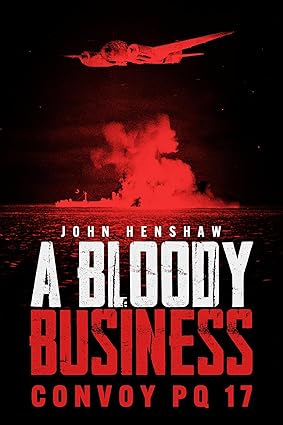
Reviews
AUSTRALIAN NAVAL INSTITUTE
Reviewed by David Hobbs (January 31, 2026)
Australian naval historian John Henshaw is a prolific writer with a distinctive style that will have become familiar to ANI members as well as the wider international audience interested in the specific ships and events he has described. The stand-out features of his work are his own excellent line drawings of ships and aircraft.
In this instance there are 47 ship, submarine and aircraft drawings spread throughout the 171 pages of text supported by 75 carefully-chosen black and white photographs and two maps, all of which help the reader to form a very clear visual impression of the subject matter. I was delighted to see on page 10 that Henshaw refers to The Allied Convoy System 1939-1945published in 2000 by my friend and RN Historical Branch colleague, the late Arnold Hague, as the ‘most authoritative work on World War II convoys’; it would be my starting point for any study of a wartime convoy. Arnold Hague and American historian Bob Ruegg collaborated to produce an earlier book, Convoys to Russia 1941-1945, in 1999. Both are listed with other titles in this book’s bibliography.
Henshaw’s method is to study a wide range of secondary sources and then conduct a forensic, day-by-day analysis of the events identify errors and inconsistencies. Interestingly he found several, including RFAs intended to refuel escorts that were not, therefore, part of the convoy itself, ships that turned back for various reasons and genuine misunderstandings that must have been carried forward from errors in original source documents. This book’s title is drawn from the verbal message passed by megaphone from Commander Jack Broome RN in the destroyer Keppel who commanded the close escort to the convoy commodore, Dowding, shortly after the disastrous order from Admiral Pound, the First Sea Lord, that the convoy was to scatter, signalled at 2136 on 4 July 1942.
The text begins with a description of how the system of convoying war supplies to North Russia was established in 1941 before looking in detail at the disaster that befell PQ 17. A chapter is devoted to events in the Admiralty’s Operational Intelligence Centre in the hours before Admiral Pound decided, against advice, to order the convoy to scatter because he feared that the German battleship Tirpitz was about to attack it. In fact it was not close to the convoy although the order to scatter led to two thirds of the merchant ships being destroyed by aircraft and U-boats. The order to scatter PQ 17 meant that there was no need for Tirpitz to fight its way through covering forces to get at it and it returned to harbour well before ever reaching the ‘killing zone’. Subsequent chapters describe the aftermath, the successful passage of subsequent convoys and Soviet reluctance to acknowledge the valuable material assistance provided by their allies’ convoys.
As a single-point reference on the subject, this book stands out because of the quality of the drawings and images together with 33 pages of appendices which list every ship and aircraft type involved with lists of their technical details. Everything needed to understand the tragedy of PQ 17 can be found within this book’s covers, but it is only fair to point out that there is another recent book that covers PQ 17, inter alia. This is Andrew Boyd’s outstanding Arms for Russia & the Naval War in the Arctic which I reviewed for ANI at the end of October 2024. It has 500 pages of text, much of it reflecting the author’s extensive research into newly released primary sources in both Russian and western archives. Although it has a significantly wider focus it also devotes a chapter to the events in the Operational Intelligence Centre in the fatal hours before the signal to scatter PQ 17 was released and another on the catastrophe of the convoy’s destruction. As might be deduced from its primary title, Boyd describes the uses made by the Soviet armed forces of the material supplied by the allies and his book has, therefore, a significantly wider scope. John Henshaw and Andrew Boyd were probably writing at the same time without either being aware of what the other was doing.
John Henshaw’s A Bloody Business is focused on PQ 17 and his drawings help to create a book that, more than any other, makes the reader aware of the individual ships’ appearance and how they performed in this, the most difficult of situations. It is a concentrated source for ‘what, where and when’ data relating to PQ 17. There is, therefore, room on my bookshelf for A Bloody Business and I recommend it.
https://hmgs.org/blog/2025/12/26/a-bloody-business-convoy-pq-17/
Reviewed by Russ Lockwood
The West sent 41 convoys and 13 individual sailings to the USSR during the war. Of the 865 merchant ships, 728 arrived (15.84% loss rate), much higher than trans-Atlantic convoys (4% loss rate). Convoy PQ-17 suffered a 66% loss rate among the merchant ships (p xv).
The book contains a full OOB of Allied and German forces involved in the battle over PQ-17, along with specs of all ships. The preparation and sailing, defensive measures, and the attacks and scattering of the ships receive a detailed look. The biggest impact came with the British Admiralty decision to scatter the convoy upon reports that the battleship Tirpitz and escorts had sailed to intercept the convoy. It proved a fatal micromanagement of the convoy.
A nice recap of the action of German air and naval attacks allows you to set out a tabletop scenario or two. Certainly, a what-if scenario could include the Tirpitz and escorts actually involved.
The book contains 75 black and white photos, 106 black and white ship drawings (overhead and profile), and two black and white maps.
It’s a well-written book that dissects PQ-17 down to individual ships and attacks. Well done.
Enjoyed it.
Reviewed by Adam Makos
My name is Adam Makos, and I am a fellow author working in character-driven history. I recently learned of A Bloody Business: Convoy PQ 17, and I felt compelled to reach out in appreciation of the clarity and moral seriousness you bring to one of the most controversial naval episodes of the Second World War.
The Arctic convoys represent a uniquely harrowing chapter of the war where diplomacy, strategy, and survival collided in some of the most hostile conditions on earth. Your framing of PQ 17 within the broader arc of 1941–42 the shock of Operation Barbarossa, the entry of the United States into the war, and Churchill’s uneasy alliance with the Soviet Union grounds the convoy’s tragedy within the immense strategic pressures of the moment.
What stands out in your description is the disciplined dissection of events down to individual ships and attacks. By reconstructing the sequence from departure through the catastrophic order to scatter, you allow readers to see how decisions made far from the Arctic seas reverberated with lethal consequence. The fateful intervention of Admiral Sir Dudley Pound, contradicting staff advice amid fears of the Tirpitz, remains one of those moments where leadership, intelligence assessment, and human fallibility converge with devastating effect.
I particularly appreciate your inclusion of detailed appendices orders of battle, merchant ship listings, and German naval and air assets. That structural rigor signals a work designed not merely to recount events, but to serve as a definitive reference for students of naval warfare. Combined with narrative momentum, such documentation elevates the book beyond a retelling of tragedy into a careful examination of command, risk, and accountability.
The story of PQ 17 is painful precisely because, as you note, the scale of the loss may not have been inevitable. Works that revisit such episodes with precision and fairness perform an important service. They honor the sailors who endured fire and ice while inviting readers to grapple honestly with the burdens borne by those making wartime decisions under incomplete information.
As an author, I have deep respect for studies that illuminate the human dimension within operational history especially where controversy and consequence intersect. A Bloody Business: Convoy PQ 17 feels positioned to become an essential contribution to the literature on the Arctic convoys and the wider Allied effort to sustain the Soviet war effort.
If you would ever be open to exploring ways to help this important work reach additional readers who value carefully researched and thoughtfully argued naval history, I would be glad to continue the conversation simply as one author recognizing another whose scholarship brings renewed clarity to a tragic and consequential episode.
With admiration for the care and rigor behind your work,
Warm regards,
Adam Makos
https://www.navy-net.co.uk/community/#google_vignette
Rating: 5.00 star(s)
PQ17 The Bloodbath Convoy
PQ 17 has spawned a shoal of books ranging from the quiet fury of David Irving to Jack Broome’s 1974 Convoy is to scatter. There are also some good battle summaries in the Admiralty Historical Section. The question to be asked is “What does this book add to the existing canon of books on PQ17?”
John Henshaw has produced a copybook example of a well-researched and documented book that is both enjoyable to the general reader and an excellent reference for those studying the subject in detail or conducting research.
For those unfamiliar with the story PQ17 was a supply convoy delivering tanks, trucks and other supplies to Russia in 1942.The convoy was heavily escorted and also shadowed by heavy units of The Fleet. The latter were to deal with any attempt by German raiders to attack the convoy. A false deduction was made by the Admiralty and the convoy ordered to scatter on the assumption the Tirpitz was about to attack.
The book chronicles the chain of events and puts them in the context of the general UK Russia convoy program of 1942.There are some harrowing details of the fate of ships survivors. There is also a look at the political background as well.
The author has meticulously researched the events but the outstanding quality of the book is the excellent line drawings of the ships. These are complimented by good quality black and white gloss photographs.
As usual Casemate print to a high quality.
John Henshaw has written works including Too Many Ships Too Late, Liberty’s Provenance and Town Class Destroyers
The main text runs to 172 pages but is followed by a glossary for the general reader, An ORBAT, Appendices of ship descriptions. Aircraft details. endnotes and a decent index. The cover price is a hefty £34.95 Kindle £20.95 but copies are about on Amazon from £32.37 and given the quality of the work represents good value for money.
A Bloody Business: Convoy PQ17
14 Apr 26
THE NAVAL REVIEW (https://www.naval-review.com/)
Rear Admiral Guy Liardet
The title is derived from the loudhailer message delivered to Commodore J C K Dowding, the convoy commodore, by Commander Jack Broome in Keppel; “Sorry to leave you like this. Goodbye and good luck. It looks like a bloody business.” The USN’s notable Captain Daniel Gallery described PQ17 as a “shameful page in naval history.” Admiral Kuznetsov in his memoirs said, “I reported the tragic case of Convoy PQ17 to J V Stalin. He was displeased with the behaviour of the British naval command. ‘Was it necessary to abandon the convoy?’ I replied that as far as I knew there were no serious reasons for that.” In my recent review for these pages of Hugh Sebag-Montefiore’s Battle of the Arctic, I recalled that Admiral O’Brien, first lieutenant of the destroyer leader Offa and afterwards CinC Western Fleet, said, “I still today have a personal sense of shame which is renewed annually…I hate 4th July, the Navy’s day of shame and mine.”
I am full of admiration for this polished and thorough account of a much-written-about topic. John Henshaw’s brief biography is of a sailor and oarsman but quotes no other academic works. Preface and Background chapters comprehensively cover the strategies of the warring nations; the seasonal Arctic environment; some statistics; the belief that after the breaking of the Molotov-Ribbentrop pact, Soviet Russia would be a useless ally liable to collapse; the fundamental choice ‘Germany First’ made by the Americans after Pearl Harbor and other issues.
The crux of the tragic PQ17 story is of course the decision to scatter the convoy. PQ17 was making good progress having beaten off air attacks with few losses. ‘Close cover’ was being provided by the heavy cruisers London, Norfolk, the American Tuscaloosa and Wichita with two destroyers. Clearly no match for Tirpitz, Scheer, Hipper and Lutzow, but falsely and fortuitously U457 mistook the bulk of London and reported a battleship with this escort force, also the presence of enemy aircraft – probably one of Wichita’s Curtiss Seagull float planes but raising the fear of the carrier Victorious. Both sides would have recalled the fate of the sister ship Bismarck, the British the gunnery that blew up Hood and drove off Prince of Wales, the Germans the flukey but fatal attack by a few obsolete carrier-borne aircraft.
Bletchley intercepted the German plan to attack the ‘next convoy’, the text shown here in full. Also, inter alia the text of a long Admiralty signal dated 27 June micro-managing the contingencies and importantly how the Admiralty will exercise control, with the possibility that the convoy’s course might be reversed. Admiral Pound had told the Home Fleet Admiral Tovey by telephone at Scapa that he was thinking of scattering the convoy if Tirpitz went after it. Tovey was horrified – it would be ‘sheer bloody murder’ – and wanted to turn the convoy round to the protection of the ‘distant’ covering force, the battleships Duke of York, the USS Washington (main armament 9 x 16inch guns), the carrier Victorious, cruisersCumberland and Nigeria with eleven destroyers.
Henshaw’s key chapter 7 entitled ‘Admiral Pound and the Operational Intelligence Centre’ explains the dilemma facing the First Sea Lord. Described is Pound’s health, his eventually fatal brain tumour, his autocratic character as a ‘master of detail’, his past career and the strain of difficult decisions, the naval disasters from Mers-el-Kebir in 1940 onwards and the string of personalities from Churchill to the Anglophobic US Admiral King that he had to deal with.
Kriegsmarine signals were not decoded in real time but Paymaster Lt-Cdr Norman Denning, the recognised top intelligence analyst, knew that when the enemy put to sea it preserved radio silence while being instructed by shore-based broadcast. Also, a destroyer sweep would have been ordered, their signals observed and their operations reported by our submarines. None of this had happened. It was known that the Germans did not know the whereabouts of the Home Fleet and this led to the reasonable belief that the Germans would not risk its ships without this knowledge. When Pound visited the OIC, he was told that Tirpitz and Hipper had joined with Scheer at Altenfiord but had not proceeded in the direction of PQ17. Denning and his superior Captain Jock Clayton and Professor Hindley of Bletchley Park were convinced that the German ships had not sailed. The First Sea Lord wanted positive evidence; all that was on offer was negative intelligence. At a staff meeting at 2000 to review the situation his advisers were opposed to a dispersal, but Pound called for a signal pad and wrote the order for dispersal.
Ever afterwards Denning regretted that he had not been more forceful, but in the structured, hierarchical Royal Navy of the time, it was simply not done to venture strong and contrary opinions to its most senior officer. What else could have been done? There was clearly the option to turn round back towards Iceland and perhaps lure Tirpitz on to the Home Fleet as shown in the Admiralty signal discussed above. This debacle lost 22 of the final 33 merchantmen to air and submarine attacks, a casualty rate probably as bad as an actual engagement with Tirpitz.
Henshaw continues with a detailed account of what happened to every ship and the politics of an ‘aftermath’ including the next strongly escorted PQ18, the first to contain a game-changing escort carrier. Amid many photographs, his book is embellished with exquisite line drawings of every warship and aircraft mentioned as well as many merchant ship types. The statistics for American shipbuilding are astonishing. He is very critical of the Russian efforts in support of the Arctic convoy campaign; “replete with the failures of the Soviets to comply with what had been agreed”; the failure to provide support for survivors; the appalling Murmansk hospital; the inadequate and never improved cargo handling arrangements; the almost complete lack of military support; a record of calculated ingratitude.
Commander Broome’s well-known libel action is described. Appendices cover the dimensions, performance and armament of every ship and aircraft, endnotes, glossary and index.
This is an admirable book which, although it covers such a well-known naval disaster, describes with unusual clarity the command and control issues which were so important to the outcome. Highly recommended. You will enjoy reading it.
A Bloody Business: Convoy PQ 17
By John Henshaw
Havertown, PA and Barnsley, UK: Casemate Publishers, 2025, 239 pp.
Review by Charles C. Kolb, Ph.D.
United States Naval Institute Golden Life Member
Setting the Stage: PQ 17 was an Allied Arctic convoy that sailed from Iceland to the port of Arkhangelsk in Russia in early 1942 and was an early, large joint Anglo–American naval operation under British command. It occurred as Germany initiated Operation Barbarossa, attacking Russia in June 1941, and joined with Britain prior to the United States’s entry into the war in December 1941. Germany had successfully attacked Norway and established naval and air strength in the Barents Sea and Arctic, leading to the Russian Arctic ports. The PQ 17 story takes place over 32 days.
John Henshaw, who currently lives in Cape Schanck, Victoria, Australia, is the author of six books on World War II. He explains (page x) that the title of this book comes from a ship-to-ship megaphone conversation at 2136 hours on July 4, 1942, between Commander Jack Broome, Captain of the “destroyer” HMS Keppel (F85), which was one of a dozen Blackwood-class frigates serving as a Close Escort for Russian-bound convoys like PQ 17. Commander Broome and the Commander of Convoy PQ 17’s 33 merchant ships, Commodore J.C.K. Dowding, on board the SS River Afton, commented on scatter tactics in response to an Admiralty order initiated by Chief of Naval Staff and First Sea Lord, Admiral Sir Dudley Pound. The order required that all the merchantmen and escorts of Convoy PQ 17 should scatter in the belief that both German Kriegsmarine surface navy and U-boat forces were about to attack the columns of merchant ships. Ultimately, 22 of the 33 merchant ships were lost because of this unfortunate tactic; 15 ships were American.
Henshaw’s drawings, maps, and photographs (all executed by the author himself) give the reader a more balanced grasp of the naval events and the ships and aircraft involved for this brief period of time during World War II. His book is organized into two narrative parts with a total of 14 chapters, five extensive appendices (pp. 177-210) plus a useful “Preface” and 49-item “Glossary.” The narratives are supplemented by 109 photographic images, two maps, six tables, 44 of Henshaw’s own drawings of ships and aircraft (two- and three-views), and 23 direct citations or quotations from the literature cited, plus 111 endnotes. His bibliography consists of 22 published, nine “electronic” [Internet], and five other sources. Five appendices provide detailed information on the Order of Battle, a list of PQ 17 merchant ships (UK, US, Soviet, Netherlands, and Panama), a list of Home Fleet vessels (six destroyers, 11 escort vessels, and two anti-aircraft ships), and separate lists of German warships and aircraft that participated in the event.
Part 1 “The Enemy of My Enemy” (Chapters 1-3, pp. 3-38) provides essential background on the early Convoy System, including a review of PQ 1 to PQ 18 departures. to Northern Russia, arrival ports and dates, and merchant vessels involved; and convoys from Northern Russia (QP) and arrival ports and dates, and merchant vessels involved. In addition, similar data is provided for JW 51A through JW 67 departures and arrivals for 22 convoys, as well as 21 returning RA convoys through 1945. Chapter 3 “Aid Comes At A Price” (pp. 19-38) documents the sailing of Tirpitz from Wilhelmshaven to Trondheim in occupied Norway, and HMS Duke of York. Photos and drawings of Luftwaffe aircraft also provide information on deployed Focke Wulf FW Condors, Ju 87 and Ju 88 level and dive bombers, and Kriegsmarine’s destroyers and Fury destroyers are also reported.
Part 2” Fire and Ice” (Chapters 4-14, pp. 14-172) covers the “Prelude to Disaster” to “Aftermath” and the 32 days of the voyage of Convoy PQ 17 from Saturday 27 June to Tuesday 28 July 1942. In the main, subsequent chapters address the Convoy’s tactics and German responses, with a chapter devoted to Admiral Pound and the Operational Intelligence Centre. Chapter 5 (pp. 49-87) focuses on Days 1 through 7, Saturday 27 June through Friday 3 July 1942, introducing returned Convoy PQ 13 to Murmansk, which became QP 13 sailing from Murmansk and consisting of 35 merchant ships, its escorts, and an RFA [Royal Fleet Auxiliary] oiler. Engagements with submerged ice and with the Germans are also recounted. Henshaw also deals with the accounts of other authors who state that there were 36 or 39 merchantmen rather than 33. He proceeds to discuss in detail each of the merchant ships, their national origins, displacement, dimensions, propulsion mechanics, cargoes, previous engagements with the enemy, ice and weather conditions, and other relevant data (eight merchantmen were US-built Liberty Ships). The chapter ends with a message from Bletchley Park that the Germans had located the westbound convoy from Russia and the eastbound convoy, and that warships were expected to move from Trondheim and Narvik, and that two U-boats were already on station (p. 87).
Chapter 6, Day 8 (pp. 88-101) focuses on Saturday, July 4, interrupted by Chapter 7 (pp. 102-108), and followed by Chapter 8, Day 8 (pp. 109-110). The initial chapter reports the detection of PQ 17 by a Luftwaffe Heinkel He 111 at 0452 hours, which also dropped a torpedo intended for the auxiliary anti-aircraft ship Palomares but hit instead the Liberty Ship SS Christopher Newport, which was abandoned and later sunk by U- 457. Six pages are devoted to Admiral Pound, his naval history, Winston Churchill, and the Operational Intelligence Center, accompanied by major quotes. The afternoon (3 pages) is expressed in the term “every man for himself,” and the Convoy scattered. The British fear of German battleships and cruisers caused a great panic. Instead of saving the convoy from disaster, Admiral Pound’s order had doomed PQ-17 to destruction.
Chapter 9, Day 9, Sunday, 5 July (pp. 111-130) is appropriately titled “Bloody Sunday.” Initially, the Kriegsmarine’s five surface ships (cruisers and a few destroyers) were joined by 33 Luftwaffe torpedo aircraft, six bombers, and up to 11 U-boats. Chapter 10, Days 10-15, Monday, 6 July to Saturday, 12 July (pp. 131-151) continues to record the loss of merchantmen as British warships escaped westwardly. Torpedo craft and especially U-boats chased and engaged the fleeing merchant ships, most of which attempted to reach Russian ports. U-334 was inadvertently damaged by a Ju 88 and had to be escorted to Norway by U-456. Nonetheless, U-88, U 334, U-255, and U-703 were successful hunters. A heavy covering force with the battleship HMS Duke of York, the aircraft carrier HMS Victorious, cruisers HMS Cumberland and HMS Nigeria, the battleship USS Washington, and nine destroyers did not engage. Chapter 11, Days 16-32, Sunday, 12 July to Tuesday, 28 July (pp. 142-151) documents the final reports from U-255, the arrival of stragglers, and tabulates the survivors and those vessels sunk, and includes non-merchant ships such as the tanker and three merchantmen that had turned back.
In Chapter 12, “Aftermath” (pp 152-160), Henshaw provides significant comments on Convoy PQ 17, beginning with USN Captain Daniel V. Gallery, who was stationed in Iceland and characterized it as “a shameful page in naval history.” Other individuals also wrote in a similar vein: Commander Jack Broome, commander of PQ 17; Russian ambassador to London Ivan Maisky; Prime Minister Winston Churchill (“after I learned the facts); Stalin’s telegram to Churchill; and like messages from Lord Winster, a Royal Navy officer, and a number of survivors of PQ 17. Chapter 13, “The Balance of 1942 and the 1943-45 Convoys” (pp. 161-165) illustrates the successful result of Convoy PQ 18 (2-21 September 1942), Operation Pedestal, in which a convoy from Scotland to Malta served to showcase another disaster; only five of 14 ships survived. In 1943, there were six convoys to Russia with 82 merchant ships; five were lost. In 1944, ten convoys with 245 ships; four were lost. In 1945, four convoys with 134 ships; two were lost.
The final Chapter 14, “Analysis and Conclusions (pp.166-172) details shipments to Northern Russia by sea and shipments to the Persian Gulf and then transit overland to Northern Russia for contrast. All five routes are statistically compared: Persian Gulf, Soviet Far East, Northern Russia, Black Sea, and Soviet Arctic. Henshaw then does something that authors generally do not do – compares his research and writing to that of other published authors. These include David Irving, who published the error-filled The Destruction of Convoy PQ 17 (by Cassell only in the UK) in 1968 and successfully challenged in court for libel and was ordered withdrawn from sale; a revised version was ultimately published in the United States by St. Martin Press in 1987. Henshaw also examines and critiques David Wragg, who authored Sacrifice for Stalin: The Cost and Value of the Arctic Convoys Reassessed (Barnsley, UK: Pen & Sword, 2005), and David Glantz and Jonathan House who wrote about PQ 17 in When Titans Clashed: How the Red Army Stopped Hitler (Lawrence, Kansas: University Press of Kansas, 1995). Lastly, Admiral Kusnetsov, Soviet Chief of Naval Staff, wrote, in Russian, Memoirs of Wartime Minister of the Navy (no citation provided). An abrupt end to a disastrous story well told.
Reviews
There are no reviews yet.